Photography Tutorial · 2018-09-27
Post-Processing Should Go from the Whole to the Parts, with Selection and Omission - Photo-Editing Mini-Contest, Episode 4 Review
Thomas Chu Photo
A tutorial every week, making photography no longer hard to learn
There is no universal formula or standard answer in photography post-processing. From the same original, different things photographers want to express, highlight, and present, as well as their different emotions, personalities, stylistic traits, and personal preferences, all make the results vastly different.
Seeing diverse post-processing approaches and forms of presentation, and learning from one another, is Thomas's original intention in holding the photo-editing mini-contest.
Let's review the 11 originals from the 4th contest, which include two bracketed exposure city images from blue hour, and a fireworks image from the same position after nightfall:
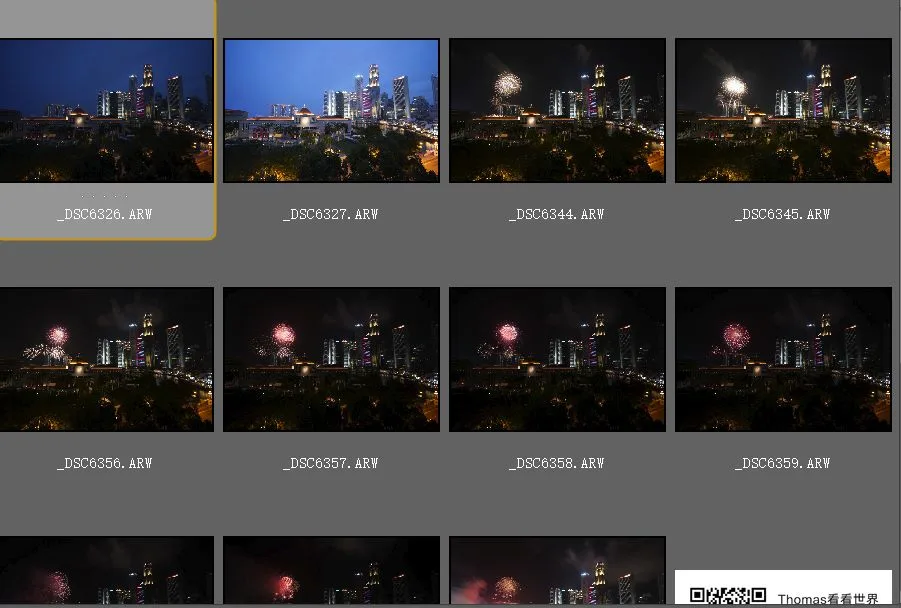
The original download address can be found in the article "Photo-Editing Mini-Contest, Episode 4 - City Fireworks Night Scene (Sony A7R3 + Laowa 10-18mm Originals)" (《修图小赛第4期 - 城市烟花夜景(索尼A7R3+老蛙10-18mm原图)》).
This contest received more than 1,000 submissions. From the same Singapore night scene original, some edited it to be dreamy, some brilliant, some solemn, some oppressive, some black-and-white, and some colorful - truly spectacular!
The excellent works finally selected by the contest only reflect Thomas's personal preferences, and only 1 photo per style is chosen for the list. Therefore, many brilliant works cannot all be listed here for various reasons.
Thomas's Selection Award No.1
Editor: 蔡少白alphabeta
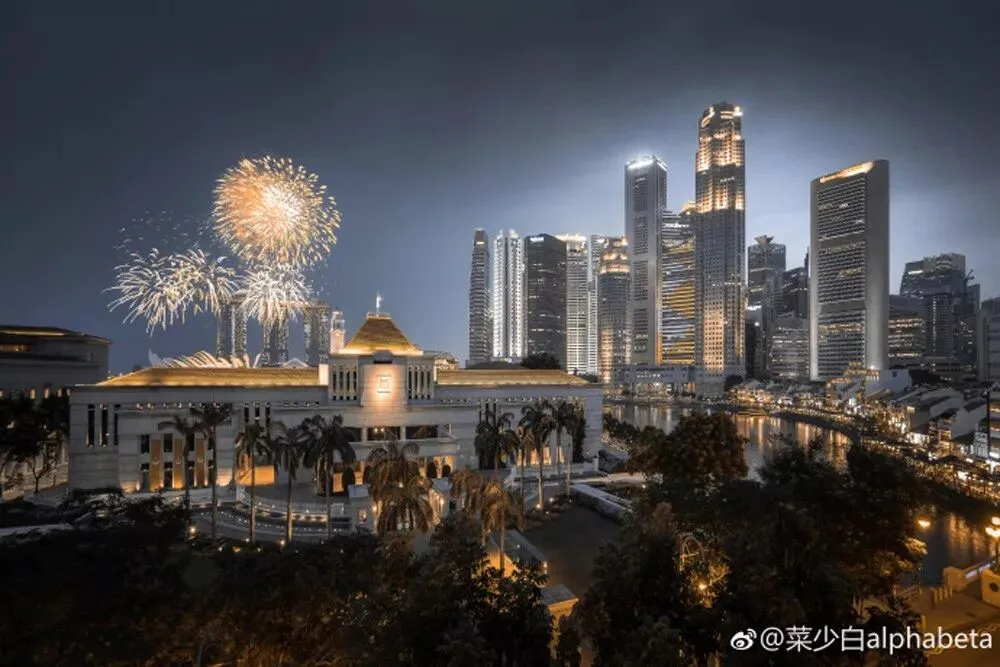
Thomas's review:
This photo is outstanding in its overall color adjustment. The city lights are resplendent without appearing messy, and the fireworks have also been graded to gold, unifying with the overall colors and reinforcing the resplendent atmosphere. The blue of the background sky is elegant and calm, serving as an excellent backdrop.
In post-processing city nightscape photos, large areas of green space and trees are a major challenge; if handled poorly, they easily ruin the overall color and tonality. The author darkened the foreground trees, reduced their saturation, and unified their hue to gold, handling this major difficulty in the image quite well.
Of course, I think there are 4 detail areas in this photo that could be improved.
First, the luminance of the trees below is darkened too much overall, creating too strong a contrast with the whole frame, which ironically makes them stand out. I suggest only darkening the highlights and midtones of the trees while appropriately lifting the shadows, so the trees are "dark but not black."
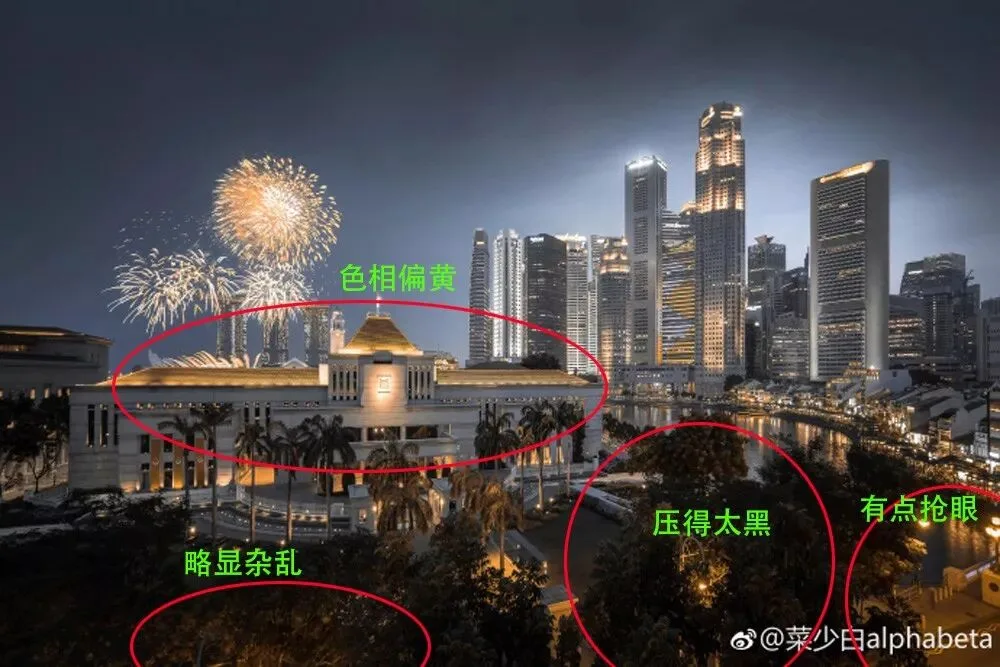
Another problem is that the hue of the warm-colored areas is somewhat inconsistent. The author's overall warm hue is gold, to highlight the glory of a modern metropolis. However, the Parliament House, which occupies a considerable area, leans yellow, somewhat breaking the overall warm atmosphere. I suggest using the "Hue/Saturation" tool or the "Selective Color" tool locally to unify it to gold.
As for the corners of the frame, I personally don't like elements that are too cluttered or objects that are too eye-catching, because these "highlights" in the corners tend to draw the viewer's gaze out of the frame.
In the dark trees at the lower-left corner of this image, a patch of red light suddenly appears at the edge, and the area it illuminates is also a bit cluttered. You could locally reduce its saturation and shift its hue toward green. As for the lower-right corner, the saturation is too high and a bit too eye-catching; I suggest locally reducing the saturation. Below is the result after my simple modifications.
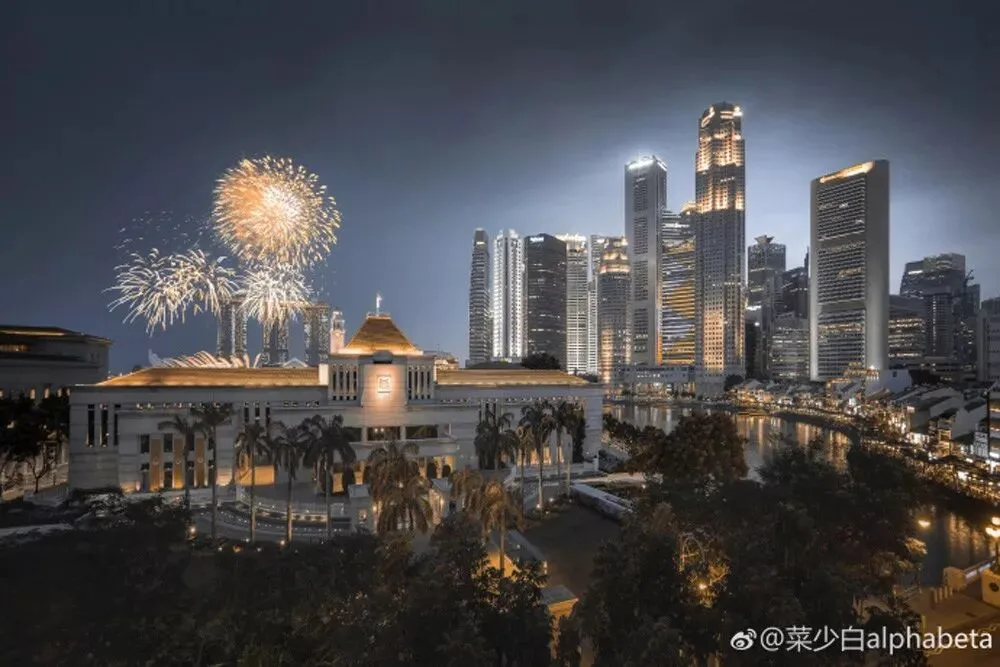
As Thomas emphasized in his new book "The Fundamentals of Landscape Photography Post-Processing" (《风光摄影后期基础》), post-processing should go "from the whole to the parts" (先整体,后局部). First make the overall image comfortable, then consider local flaws and details. Because the overall adjustment of this image is already outstanding, it still won Thomas's Selection Award.
Thomas's Selection Award No.2
Editor: Stephen_N
Thomas's review:
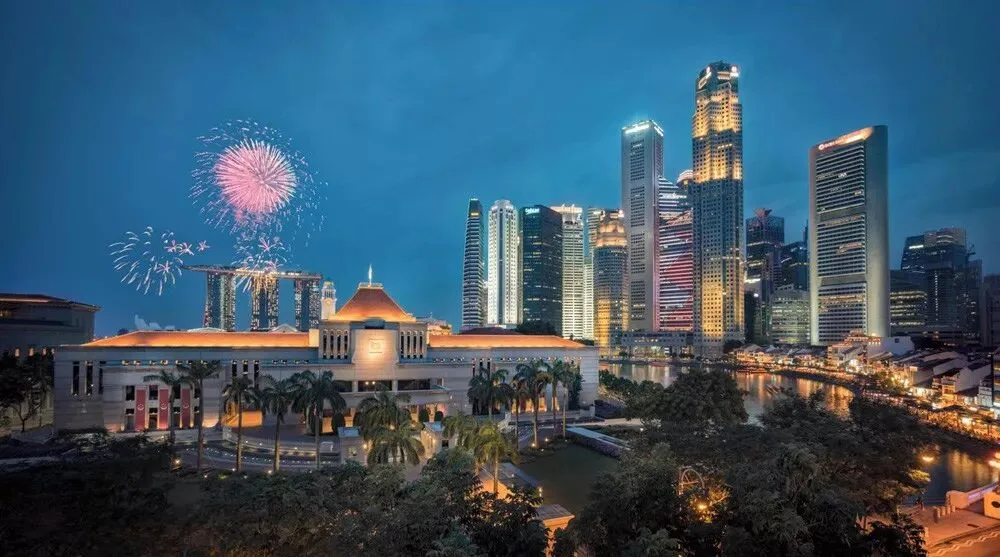
A city night scene can not only be resplendent but also colorful. Among the many submissions, this work does an excellent job of presenting the colorful lights of Singapore's city night.
The frame contains blue, orange-red, orange-yellow, green, and purple - very rich in hue - yet the overall look doesn't seem messy.
The author balanced the areas of the various colors well and kept the same colors as concentrated as possible in regional distribution, avoiding the messiness of the same color scattered in patches here and there. The author's post-processing skill is impressive.
Thomas's Selection Award No.3
Editor: Panfofo_Fanto
Thomas's review:
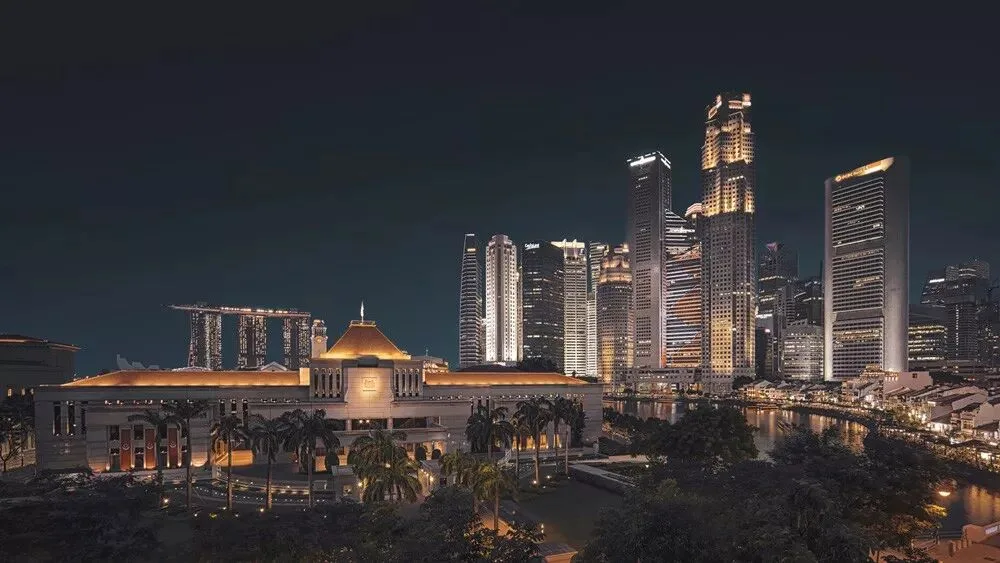
As Thomas emphasized in the book "The Fundamentals of Landscape Photography Post-Processing" (《风光摄影后期基础》): "Technique serves form, and form serves content." Depending on the content a photo is meant to express and the atmosphere it wants to highlight, not only do tonality and color differ, but composition and the choice of elements should also involve selection and omission.
More elements in a frame is not always better. We often see some poorly done edited works where the Milky Way, fireworks, the moon, car trails, magical clouds, hot air balloons - all sorts of things - are Photoshopped in all at once, PS for the sake of PS, leaving people baffled.
Although Thomas provided fireworks material for this contest, whether to edit in the fireworks depends on what the author wants to express. The two excellent works earlier - one expressing glory, the other expressing colorfulness - made it very reasonable to include the fireworks material.
But what if you want to express the solemnity, the magical feeling, or the oppression of a steel-and-concrete metropolis? For these emotions, adding fireworks material, which represents celebration, would seem out of place.
The author of this work uses a rather solemn overall color scheme: the sky is large areas of dark cyan, the warm colors are unified to gold, and the buildings are perfectly horizontal and vertical, giving the city a strong sense of order and solemnity. So adding fireworks material to this image would be out of place.
For a work like this, the difficulty is not just the idea of not choosing fireworks; more importantly, it's how to render the photo's atmosphere so that the reason for not including fireworks holds up. For this image, the author gave a great answer.
Selection Award prize: the 999-yuan
Feiyu SPG2 smartphone gimbal
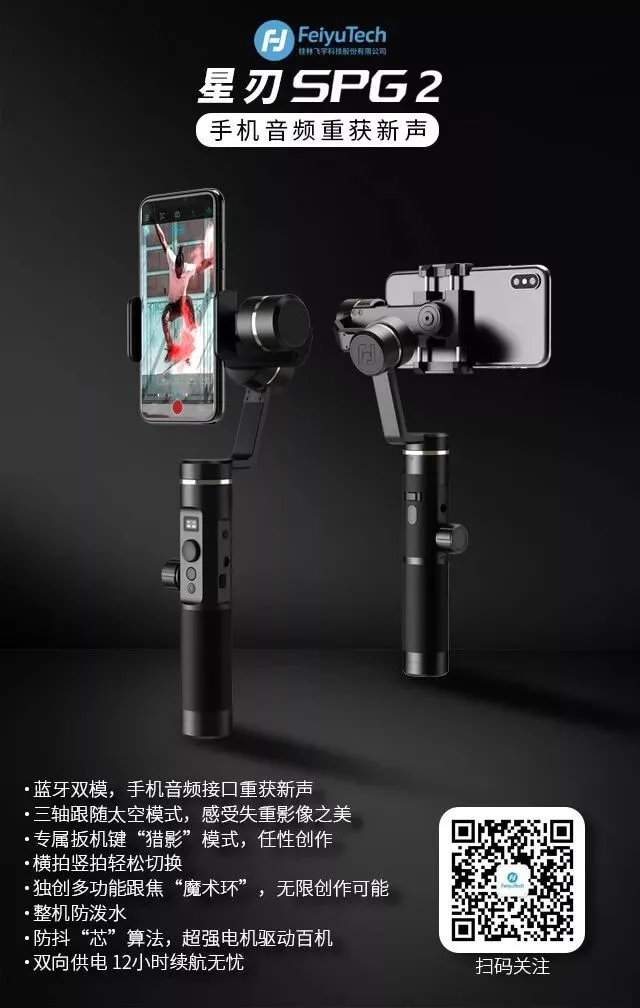
Winners, please leave a message to contact Thomas to claim your prize.
Special bonus: after obtaining consent, the three winning works will be credited with the editors' names and published as editing case studies in Thomas's future online tutorials and published books.
Follow @Thomas Chu Photo,
and learn one photography skill every week.
Click "Read the Original" at the end of the article to join the course "Making Post-Processing Effortless - The Nik Collection Smart Workflow Series" (《让后期无比简单 - Nik Collection智能工作流系列课》)