Photography Tutorial · 2017-03-29
Finding Intimate Beauty in Ordinary, Cluttered Scenery
Wide angle isn't the only answer in landscape photography. Facing cluttered scenes, ordinary subjects or overused viewpoints, switching to a telephoto to capture intimate details often makes your photos shine brighter.
In today's article, AdventureX photographer Shi Yanbing explains how to shoot intimate landscapes.
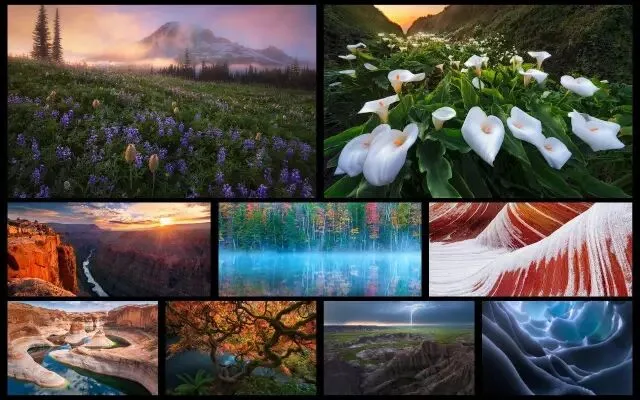
What Is an Intimate Landscape?
Grand landscapes — what enthusiasts commonly call 'epic shots' — usually share several key traits:
1. Depth: a typical grand landscape has a distinct foreground, midground and background.
2. Breadth: most grand landscapes are made with wide-angle lenses. The superhuman perspective and the visual punch of edge distortion are love-at-first-sight weapons.
3. Multiple elements: depth and breadth mean a rich variety of elements — gorgeous skies, blooming wildflowers, beautifully shaped streams — combined and echoing one another, the common grammar of grand landscapes.
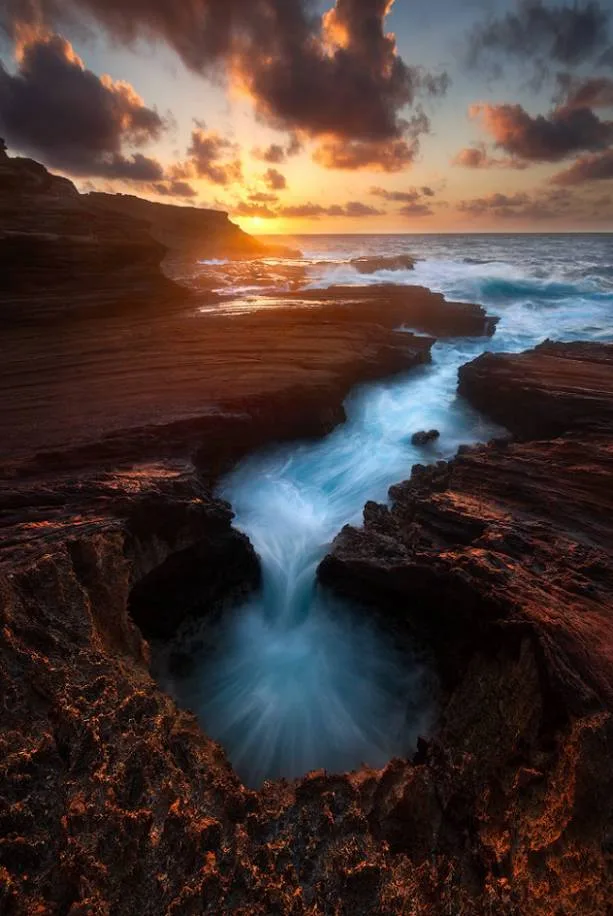
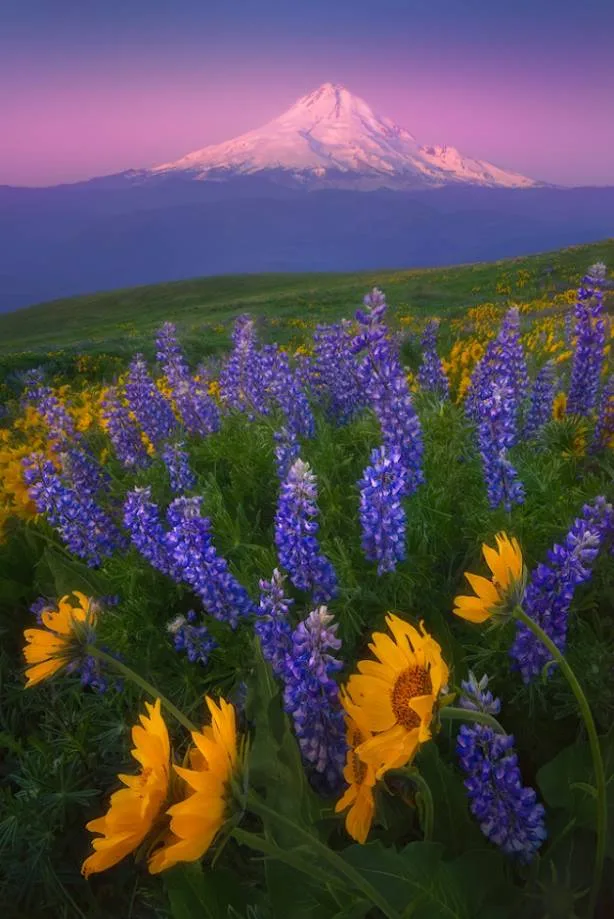
The following two images are traditional grand landscapes, both shot at 16mm ultra-wide, with focus stacking for front-to-back sharpness to maximize visual impact:
In sharp contrast, intimate landscapes have entirely different traits:
1. A relatively narrow view: unlike the first-glance shock of a grand landscape, the intimate landscape concentrates on one small part of the scene. The choice of that part fully reveals the photographer's meticulous observation of the environment.
2. Attention to the patterns of local detail: because of the narrow view, intimate landscapes contain few kinds of elements. Precisely for that reason, a good intimate work is far more demanding about the shapes, forms and arrangement of those few elements.
3. Atmosphere and mood: many intimate landscapes aim to convey an overall atmosphere or artistic mood rather than highlight any specific object; they don't even require an obvious visual anchor in the frame.
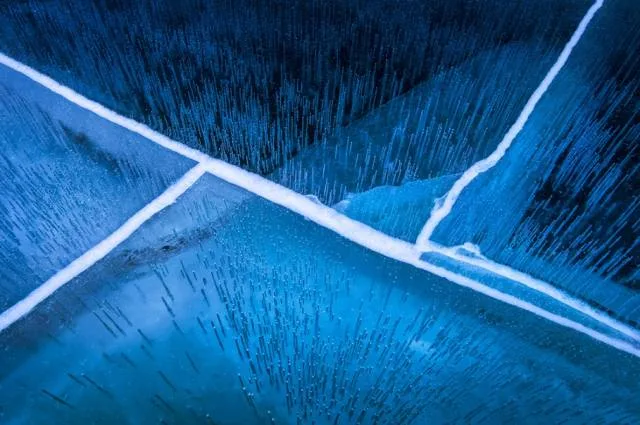
'A Thousand Needles, Exactly' — shot on the frozen shore of Lake Superior, Wisconsin, USA
If these definitions of the intimate landscape still feel abstract, the following real-world examples will illustrate its subjects, traits, techniques and thinking — hopefully giving you a fuller, more vivid understanding.

Simplifying the Complex
Nature is intricate. The bigger the scene and the wider the view, the more clutter enters the frame, hurting the overall expression. So grand-landscape shooting often means racking your brain on location for angles that avoid clutter — or spending hours in post erasing, healing and cloning out distractions.
But not every scene yields to such front-and-back effort. When that happens, step back and ask: could I change focal length, zoom in, and carefully select a clever detail to simplify the scene decisively?
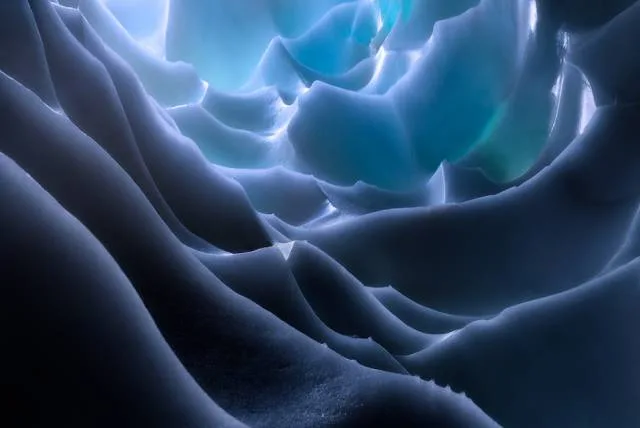
Example 1: 'Frozen' — a nameless snow cave in North Cascades National Park, Washington, USA
Let me use 'Frozen' to introduce this way of thinking. The photo came from a snowy hike in North Cascades National Park.
The Cascade Range runs from British Columbia in Canada through Washington and Oregon to California, with more than a dozen snow peaks along it. The original goal of this hike was to photograph the famous autumn view of Mount Baker.
Sadly, the weather didn't cooperate — the mountain fog never lifted to reveal Baker, and all hope of a sunset epic evaporated. But halfway up, I spotted a small glacier, and beneath it, hidden away, a snow cave less than a person's height.
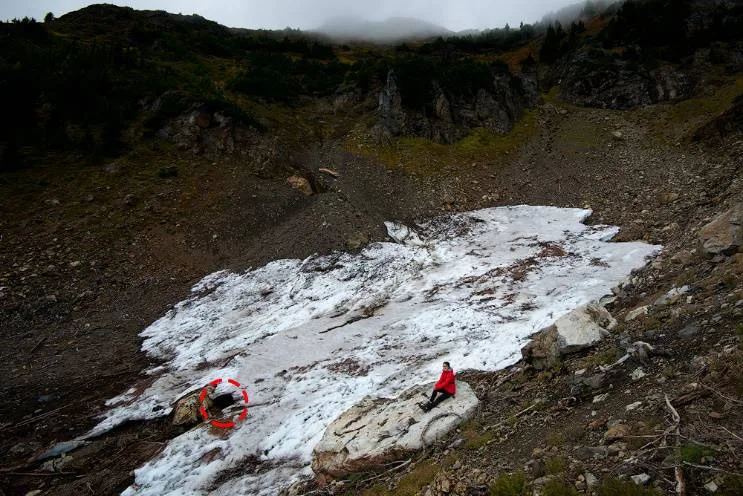
Marc Adamus's dreamlike snow-cave image 'The Deep Blue' instantly flashed through my mind, and I scrambled inside in one go. But the interior was nothing like the dream: branches sprouted from the floor, rubble everywhere, and blotchy mud clung to the walls.
Faced with such a cluttered scene, I felt there was no composition at all. After much straining, I got only the panorama below — and even that took hours of cleanup in post — a far cry from the grand snow-cave works of Marc Adamus and others.
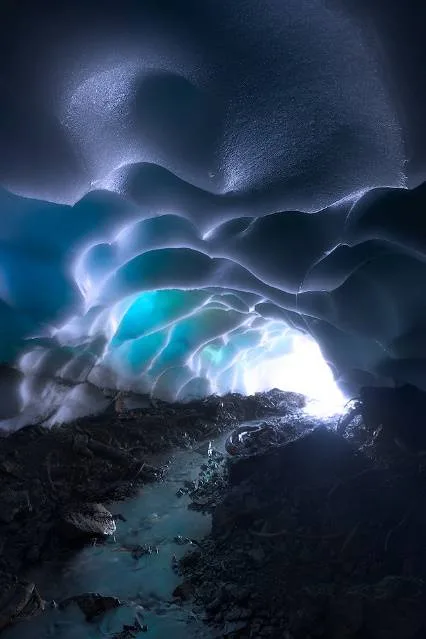
Without a satisfying wide composition, I changed tack: mounted the 70-200 telephoto and began considering the cave's details. Because the telephoto view differs markedly from the eye's natural mid-range view, my habit is to hold the camera to my eye and search through the viewfinder for fragments — usually far more effective than judging with the naked eye.
For this scene, my fragment-hunting followed these ideas:
1. Light: express the crystalline translucence of sunlight seeping into the cave.
2. Layering: choose the parts of the wall with rich, regularly oriented strata.
3. Clean and simple: exclude the wall's more flawed sections from the frame as much as possible.
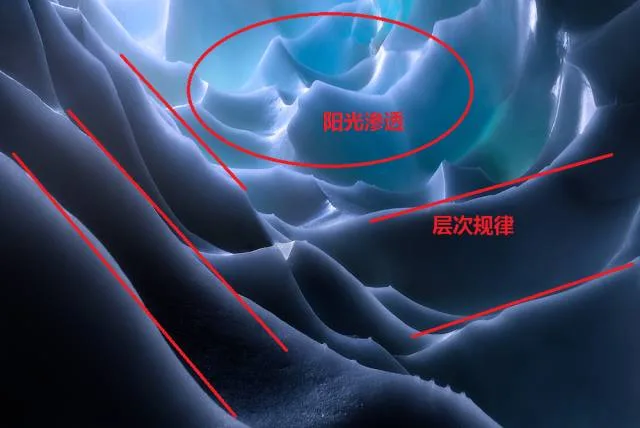
After careful searching, trying and thinking, 'Frozen' reached its final form. Notably, its post-processing continued the same three ideas:
1. Light: following how the eye reads an image, I flipped the photo vertically in post so the reflective highlights sit at the top, drawing more attention; local brightening with a brush further strengthened the sense of sunlight seeping in.
2. Layering: locally darkened the shadows around the edges while keeping each stratum's edge bright to emphasize the contour lines.
3. Clean and simple: used the clone tool to further repair the unavoidable small flaws on the cave wall.
Thanks to the intimate-landscape idea of simplification, I came away from a non-ideal cave with a distinctive, personal, hard-to-replicate work. Had I stubbornly insisted on the panorama, I'd have gone home with a knock-off, cluttered version of 'The Deep Blue'. A successful work also needs a clear line of thinking — one that runs through both capture and post.
Patterns of Arrangement
One category of intimate landscape focuses on the arrangements of subjects — the happy accidents nature creates. Most of these features reduce to simple combinations of points, lines and planes. The layering mentioned earlier actually belongs to this category too: layers are essentially planes arranged by distance, their contours rendered with different light and sharpness to inscribe a pattern that conveys depth. Here are more examples extending this line of thinking.
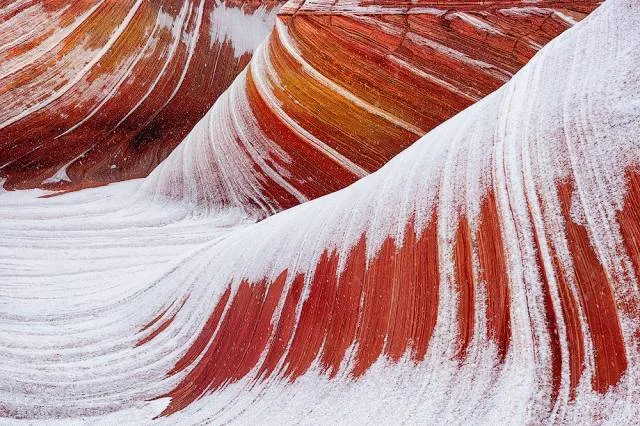
Example 2: 'Red and White' — shot at The Wave, Arizona, USA
In this internet age of exploding travel and image information, The Wave in Arizona is all too familiar to photographers — its photos may already cause aesthetic fatigue. But this 'Red and White' might refresh your eyes; at first glance you may not even recognize the location. It's commonly believed the best condition at The Wave is noon, when direct sunlight sketches the rock's natural grain into 'waves'.
'Red and White' was shot on a heavily snowing morning: the sky a pale white, visibility extremely low, no direct sunlight at all. Because the Wave's walls are near-vertical, snow can't cling to them for long. In a brief pause between snowfalls, as the snow slid off the walls, the rock's grain was crisply outlined and set off by the remaining white snow. This magical state lasted only two or three minutes before the rest of the snow fell away.
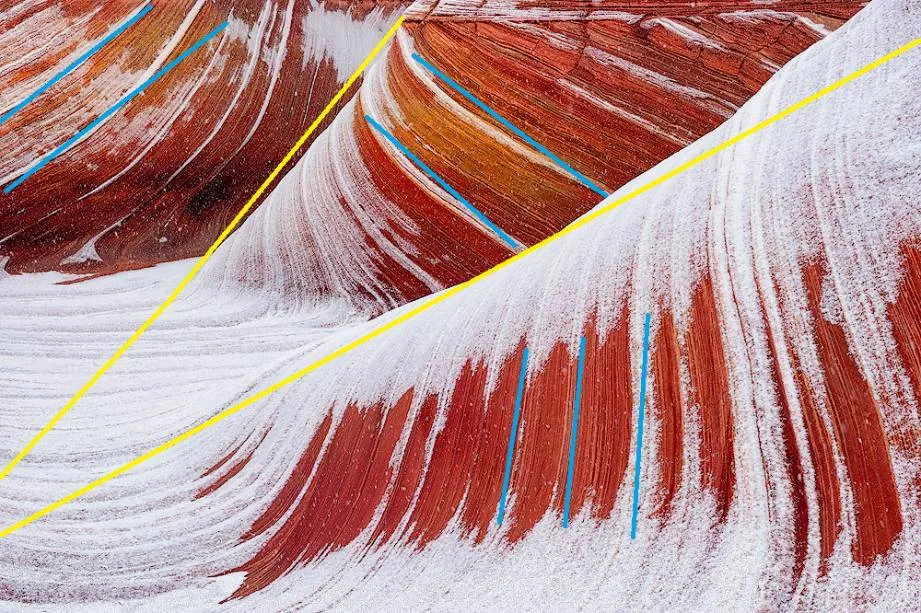
The idea for this photo was clear: find the fragment where the texture lines are crispest and most regularly oriented. As the analysis diagram shows, three rock walls — near, middle and far — divide the frame into three triangular zones, each with its own orderly grain direction. To emphasize the lines purely and simplify the frame, I rigorously excluded any sky and included only a small patch of pure white ground.
The edit followed the same line-emphasizing logic: slightly boosted the reds' saturation and brightness, raised overall contrast to separate red from white, using color differentiation to further carve out the lines.
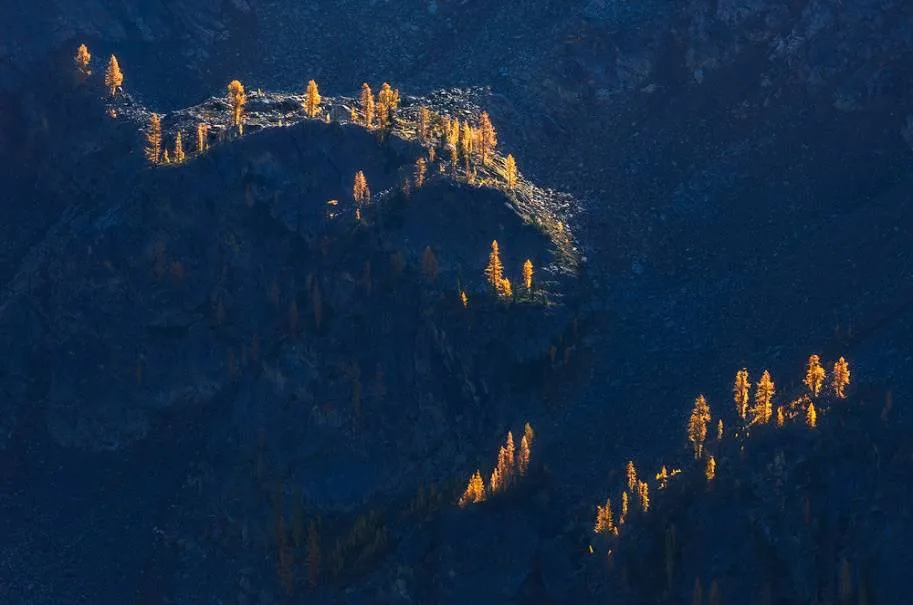
Example 3: 'Touching Stone into Gold' — golden larches in autumn, North Cascades National Park, Washington, USA
Beyond lines, arrangements of points can also make brilliant intimate works. 'Touching Stone into Gold' was likewise shot in North Cascades National Park. Every autumn, the golden larches on these peaks show their most vital colors and postures.
The photo was actually taken well past the golden half-hour around sunrise — that morning was a cloudless 'flat-light day', and the planned sunrise shoot yielded nothing.
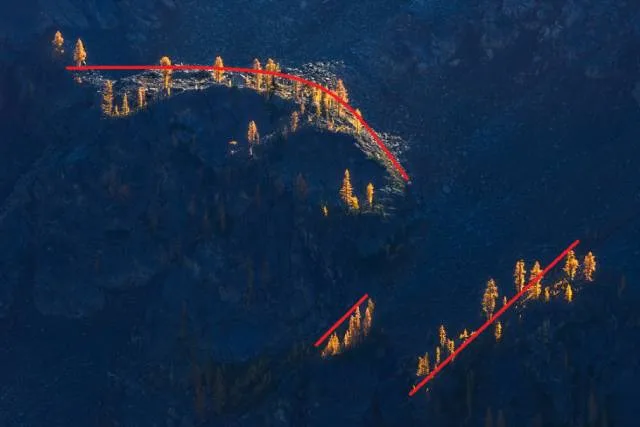
As the sun climbed to a certain height, I noticed the sparse golden larches on the distant vertical cliff would just catch the sidelight. Smelling an intimate-landscape opportunity, I began searching the cliffs with a telephoto for larch formations with clear patterns. After several fragments, I finally found this relatively clean arrangement.
The editing logic mirrors 'Red and White': strengthen the warm-cool and light-dark contrast to spotlight the 'points' in highlight, while letting the cliff's shadow zones recede.
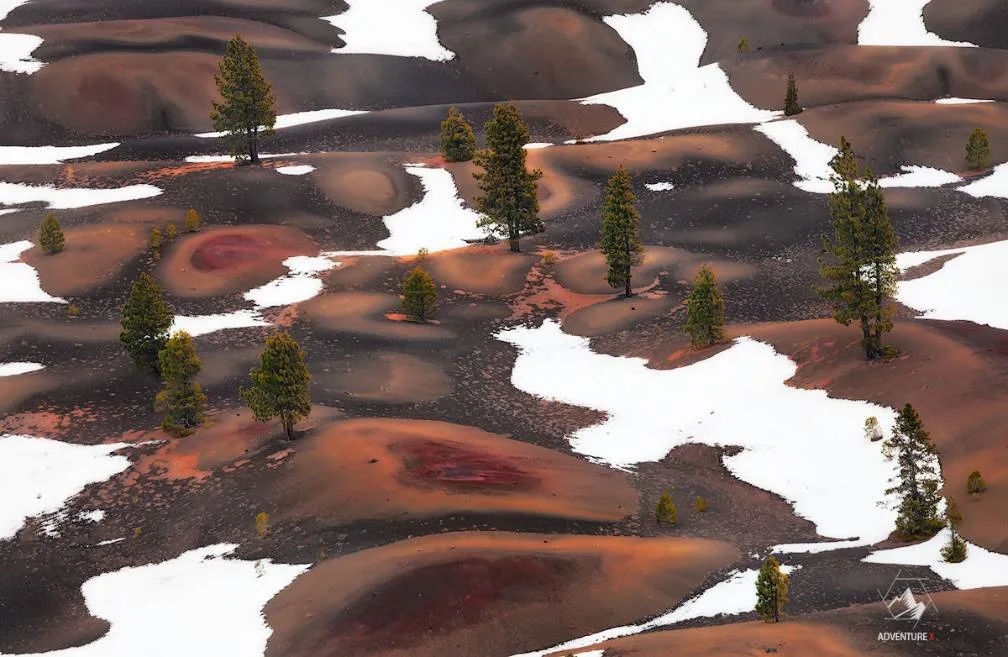
Example 4: 'Puzzle' — by AdventureX photographer Pan Weihao
With points and lines, planes can't be left out. AdventureX photographer Pan Weihao's 'Puzzle' cleverly combines the natural patterns of a volcano's surface with local snow patches shaped by the terrain. Two colors and two brightnesses interlock, dotted with trees scattered between — a perfect demonstration of arrangement in intimate landscapes.
The patterned arrangement of points, lines and planes is a relatively abstract photographic technique for revealing nature's subtlety. Using it well depends on the photographer's meticulous observation and imagination.
While hiking, scouting and shooting, slowing your pace, noticing scenes large and small around you, and cultivating sensitivity to local light all raise your chances of catching such scenes. Conversely, enthusiasts who pre-decide exactly what they'll shoot and charge straight at the subject often miss these discoveries.
Landscape photography isn't a TVB drama where you know the ending from the start. Unexpected discoveries born of patient observation add to photography's joy — and train the photographer's artistic cultivation.

Texture
As we all know, a photo is a two-dimensional medium. If points, lines and planes are relatively easy to show in 2D, then texture — a three-dimensional concept — further demonstrates the intimate landscape's subtlety. Emphasizing texture usually rests on two key elements:
1. Light and shade: under light of the right direction and intensity, tiny pits, bumps and layers on a surface are naturally separated by shadows and highlights, and this tonal contrast naturally creates three-dimensionality on a flat medium. Anyone who has studied sketching knows the method well.
2. Color: the multicolored patterns formed by different mineral compositions in rock, the color gradients formed by varied light on leaves — changes of color also imply changes of texture.
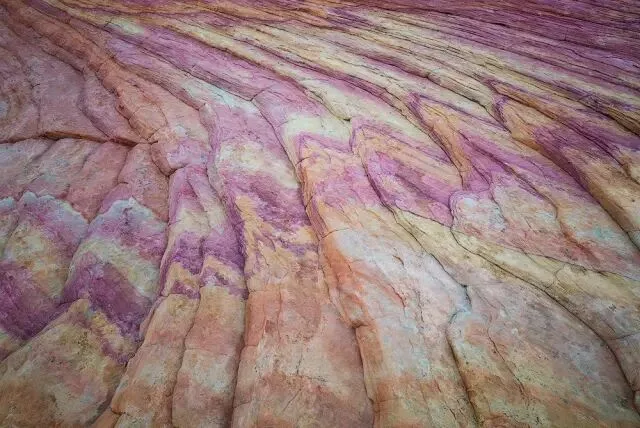
Example 5: 'Crazy Hills' — shot at Valley of Fire State Park, Nevada, USA
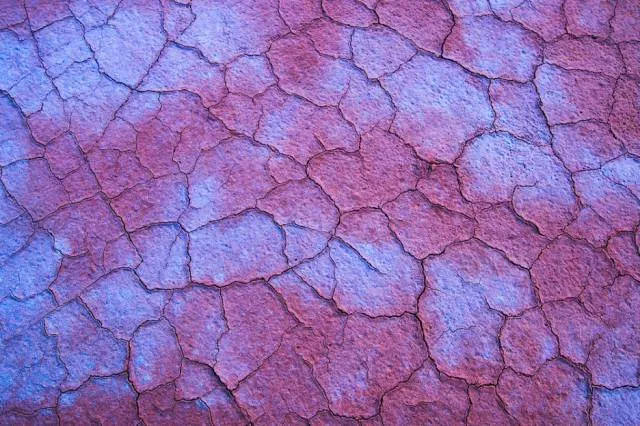
Example 6: 'Colored Badlands' — shot among the mushroom hoodoos of Utah, USA
'Crazy Hills' and 'Colored Badlands' show the textures of rock strata and badlands respectively, and they share much. Both use the softest diffused light of the Earth's shadow (Belt of Venus) after sunset — soft, subtle, diffuse reflected light usually serves texture better than harsh direct light. Both combine tone and color to reveal the flaky layering of strata and the dry cracking of badlands. Yet their shooting angles differ.
'Colored Badlands' uses strictly flat shooting: the lens is perpendicular to the subject, and everything in frame lies on the same focal plane.
Flat shooting is the most common method for intimate textures. Its strengths: clear focus of attention, minimal distortion, and no need for great depth of field. Its difficulty: it's picky about surface structure. If the surface has only fine grains or gentle undulations, no lighting angle can carve the texture strongly.
'Colored Badlands' overcame this drawback thanks to its strongly undulating, distinctive cracks and its red-and-white color interplay.
'Crazy Hills' is a typical non-flat shot — the lens is not perpendicular to the surface. For non-flat shooting, when choosing position and angle you must watch the light's direction and softness closely to create the most harmonious dimensional effect.
The difficulty is that, wide or telephoto, depth of field easily falls short, leaving large corners of the frame out of focus. If the blurred corners sit in inconspicuous shadows, that's tolerable; in highlight or highly saturated areas, they distract and ruin the image.
While shooting, frequently zoom in on the camera LCD and check sharpness across the frame. A smaller aperture plus a tripod solves most depth-of-field issues; a few extreme cases also require multi-frame focus stacking.
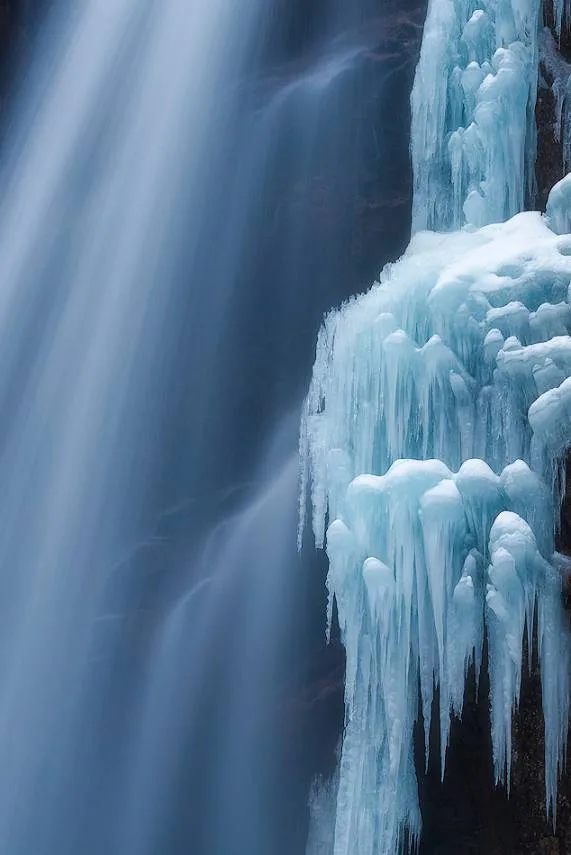
Example 7: 'Hard and Soft in Harmony' — Franklin Falls, Washington, USA
When neither light nor color is ideal, texture can still be expressed. 'Hard and Soft in Harmony' was shot on an overcast winter day: no ideal light, the whole scene shrouded in monotonous blue. Yet the silky long-exposure water contrasts with the icy needles of the frozen falls, setting off two utterly different textures. This example aims to inspire: photography has no formula, but it can be full of imagination — and intimate landscapes most of all.
Atmosphere
From the obvious 'simplifying the complex', to the understandable 'arrangement' of points, lines and planes, to the somewhat fuzzy expression of 'texture', our categories of intimate landscape grow ever more abstract. The apex of this abstraction is the final category: atmosphere.
Atmosphere — also called artistic mood — is something you can't describe or touch, yet definitely feel. It often springs from the photographer's emotions within a specific environment, conveyed to the viewer through the rendering of the photo.
Atmospheric intimate scenes are flexible and varied: clouds, fog, frost, dew, snow and many other weather conditions are superb material. There are no compositional rules either — the frame may include an iconic feature, or have no clear visual anchor at all. As long as the overall effect properly presents a definite atmosphere, the work has achieved its purpose.
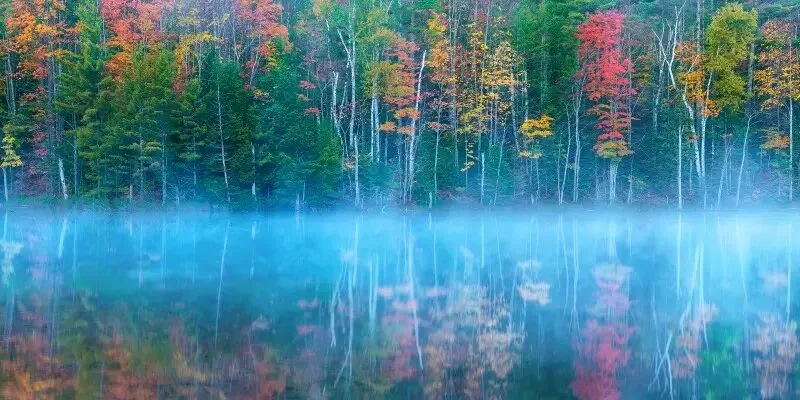
Example 8: 'Lake in a Dream' — autumn colors of northern Michigan, USA
'Lake in a Dream' came from an autumn trip to northern Michigan. Days of drizzle and the low temperatures of late autumn had dampened our spirits for photography and sightseeing alike. On the last day, with no hotel available, we camped by an obscure little lake. After a drizzly night, I was jolted awake at dawn by a gunshot — stepping out of the tent in alarm, I realized it was hunting in the distant woods.
When the shooting stopped, the surroundings fell so quiet I could hear only my own breathing. Walking to the lakeshore, I found that as the temperature rose, a thin mist floated on the lake. Windless, the surface was a mirror, presenting the hazy reflections of the multicolored maples on the far shore. The air was fresh, the mist swirling. The photo's final effect accurately reflects how it felt to be there — serene, fairylike. Reaching that effect took not only favorable timing and place, but also some subjective processing.
The main method was color adjustment in post: shifting the overall tone toward cyan-blue, and individually tuning the trees' reds, yellows, oranges and greens toward their tender, brighter variants — a 'fresh and clean' grading approach borrowed from portraiture — to evoke the feeling of 'after fresh rain in the empty mountains, autumn approaches with the evening'.
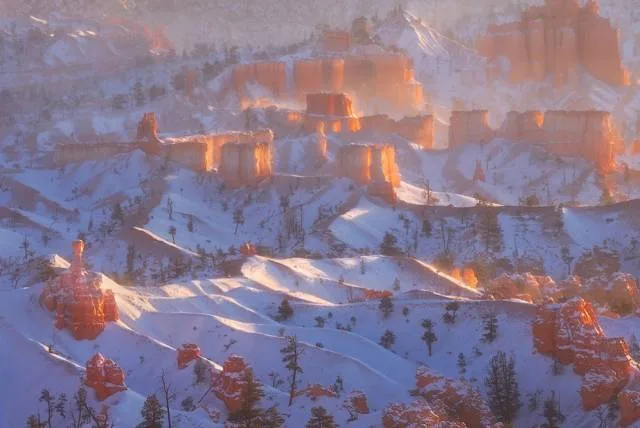
Example 9: 'Flying Snow Across the Sky' — Bryce Canyon National Park, Utah, USA
Unlike the quiet of 'Lake in a Dream', 'Flying Snow Across the Sky' expresses an alternation of cold and warm.
Shot on a winter morning in Bryce Canyon. Due to the high elevation, winter temperatures there drop to −25°C. Icy wind carried gusts of snow; in crampons, I shivered at the spot before sunrise, gnawing a hard, freezing biscuit.
Yet barely ten minutes later, when the sun crossed the horizon and its first rays kissed the hoodoos, it was as if the whole sleeping stone forest awoke — as if the cold had been swept away entirely.
The composition of 'Flying Snow Across the Sky' has no one or two dominant hoodoos; it conveys the scene's atmosphere mainly through the glow of light, the haze of the distance, and the cold-warm color contrast.
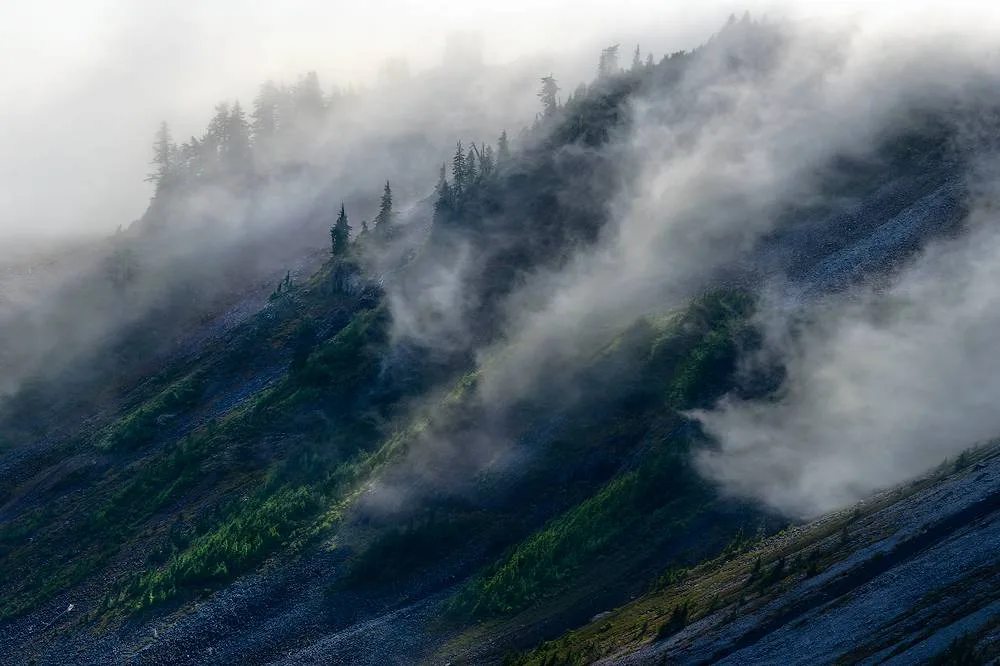
Example 10: 'An Avalanche of Mountains' — Mount Shuksan, Washington, USA
Atmosphere comes in many kinds. If the previous two examples feel peaceful and harmonious, 'An Avalanche of Mountains' embodies the peril, oppression and gravity of the high mountains.
Mount Shuksan is called the most photographed peak in America's Cascade Range. Yet this composition includes none of Shuksan's iconic features — it merely zooms in with a 200mm telephoto on a small slope of a side ridge.
What truly builds the atmosphere is neither the slope itself nor its sparse pines and grass, but the cloud and fog diving down like an avalanche. Again using no dominant feature to catch the eye, the image creates an overall feeling through specific weather, purposeful composition, and a dark, low-saturation treatment in post.
Why Shoot Intimate Landscapes?
After so many examples, you may still wonder: what exactly is good about intimate landscapes? Why should I try and pursue them? Hopefully this summary answers that.
May this introduction inspire you on your landscape-photography journey — to dig out more personal, original subjects and expressions, rather than endlessly copying popular styles.
1. Intimate landscapes more easily show the photographer's subjective originality
Grand landscapes can certainly be innovative too — but their innovation is far more constrained by the environment, especially terrain. Many so-called epic shots, especially at popular spots, more or less repeat others' works; what changes is usually just the weather, not the photographer's own ideas. Such near-identical repetition greatly discounts a work's artistic value.
Conversely, in the same scene under the same weather, the intimate landscape's potential and choices are unlimited. That abundance gives photographers a stage to show their individual prowess and create works that are personal and truly their own.
2. Intimate landscapes are hard to replicate
You've probably noticed from the examples that many intimate works depend on specific natural and lighting conditions — conditions that are fleeting and usually unpredictable.
Moreover, the angles, framing and even locations of intimate landscapes are often improvised on site, carrying randomness and uncertainty. Return to the same scene the next day and you may never recover the identical composition.
So the vast majority of excellent intimate landscapes are extremely hard to reproduce. Rarity breeds value — and that underpins the worth of a good intimate work.
3. Intimate landscapes are lenient about sky and light, greatly raising your keeper rate in non-ideal conditions
At first glance this contradicts the earlier claim that 'many intimate works depend on specific natural and lighting conditions'. But think of the great grand landscapes you've seen and shot: most demand gorgeous skies and dramatic clouds — a rather singular requirement.
The intimate landscape, by contrast, asks almost nothing of the sky and needs only local light. And even that local light depends on no particular form — direct, diffuse, scattered, even dim or flat light can all produce excellent work.
There's a famous maxim in landscape circles: 'all light is good light'. Applied to intimate landscapes, it couldn't be more fitting.
4. Intimate landscapes reward persistence and accumulation
A single intimate photo can seem thin, less eye-catching than a grand landscape. But accumulate them: when multiple intimate works of the same place or theme form a series, their overall depth and lasting appeal in expressing a region, its geology, climate, time and atmosphere far exceed what any single epic can reach.
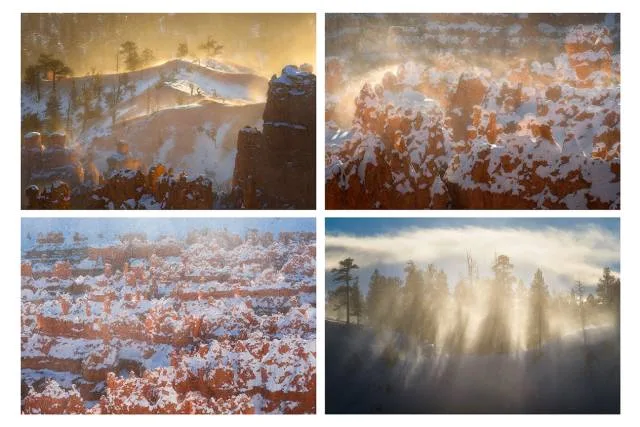
'Warm Winter Sun' — shot at Bryce Canyon National Park, Utah, USA
(The End)