Photography Tutorial · 2018-08-12
Is Photography Just Pressing the Shutter?
Thomas Chu Photo
One tutorial every week — making photography easy to learn
Author of this article: Terry-F
Originally published by "澳洲扫海帮" (Australian Seascape Group)
"What's so great about photographers? Isn't it just pressing the shutter?"
Yet many people don't know the difference between a photographer pressing the shutter and an ordinary person doing so. And for photographers: have you prepared yourselves for that press of the shutter?
Take myself as an example: when I first started photography,
I wanted to shoot something like this:
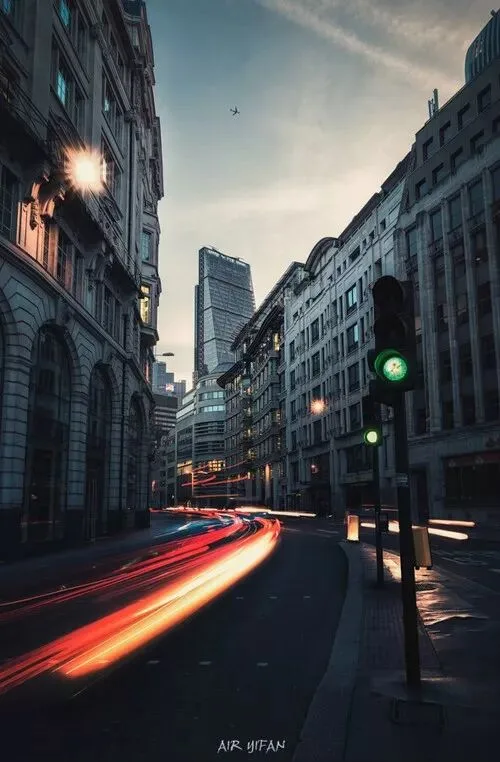
(Image author: Air&N2 --- http://ken-cyf.lofter.com/)
Yet what I actually shot looked like this:

The same press of the shutter — why is the outcome so different?
To explain this question, we have to start with the work itself. A photo is undoubtedly composed of two key elements: ideas and technique — and each of these can be divided into many parts. See the table below.
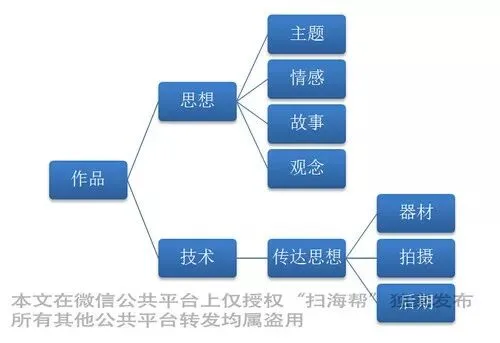
1
Ideas Are the Core Content
If a photographer lacks ideas when shooting, his work may get stuck at the threshold of saccharine, "fresh and cute" pictures. Whether portrait, landscape, or documentary — without ideas, images degenerate into mere form, amounting only to something fresh-looking or a pretty wallpaper.
So before pressing the shutter, we should first answer a multiple-choice question of our own:
A. A narrative subject with a clear theme
B. Expressing or evoking a pure emotion
C. Interpreting some subconscious, concept, or idea
D. Discussing questions of geometry, aesthetics, or even philosophy
No matter what you have experienced or what you want to shoot, this step of thinking should be carried out. I will analyze these directions of thought below.
Option A: A Narrative Subject with a Clear Theme
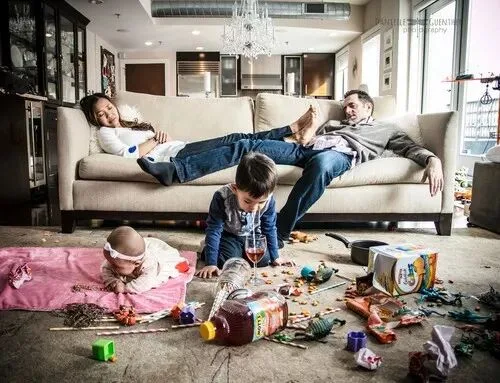
The story can be someone else's story, the photographer's own story, or a fictional story based on experience. Telling a story often uses a photo series to unfold the plot, though a single image can also work.
For example, Danielle Guenther's creative family-themed images
Option B: Expressing or Evoking a Pure Emotion
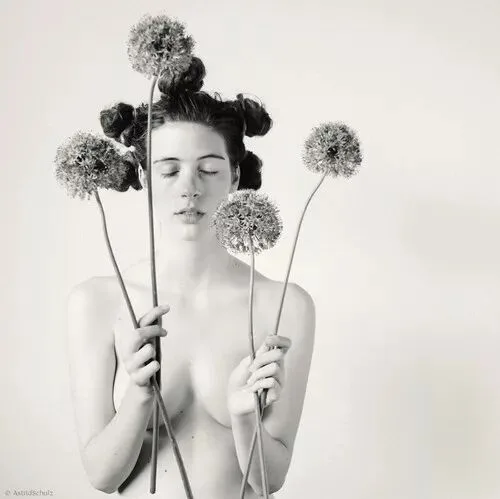
No explicit story or profound philosophical reflection is needed — the emphasis is on emotional expression. Emotion-themed photography is not limited to portraits; it can also be landscape or documentary.
Expressing emotion cannot necessarily be achieved by finding a girl to toss her hair, smoke a cigarette looking decadent, or deliberately shooting out of focus. Those are all forms; the substance requires the photographer to think thoroughly and prepare before shooting.
For example, Astrid Schulz's portrait photography
Option C: Interpreting Some Subconscious, Concept, or Idea
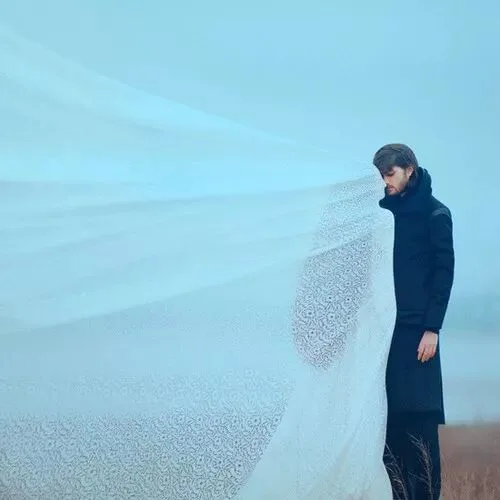
This requires the photographer to dig deep into himself, peer into his innermost depths, and then reassemble and present the concept or subconscious through imagery.
For example, Oprisco's conceptual photography
Option D: Discussing Questions of Geometry, Aesthetics, or Even Philosophy
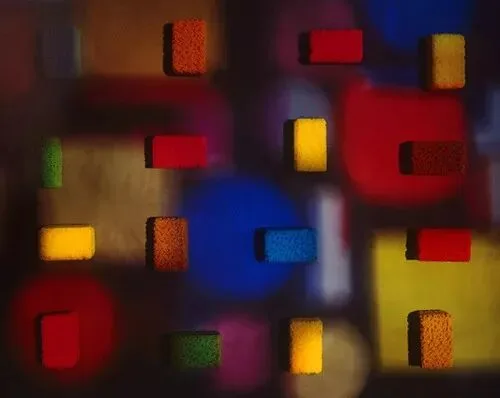
Discussing this kind of question requires more rigorous conception and bolder experimentation. It also requires the photographer's own long accumulation in this area, plus mastery of reasonable ways to pose the question and develop the reflection.
For example, Jacky Redgate's fine-art photography
In practice, the four points above all intersect to a greater or lesser degree. Almost everyone possesses this kind of comprehensive thinking ability — it's just that many people cannot connect these questions and convert them into visual information.
2
Technique Serves to Convey Ideas
Different ideas require different techniques. Technique needs to be adequate, but in reality it is only a tool for realizing ideas. Here I use two cases of my own to analyze how to use technique to convey ideas.
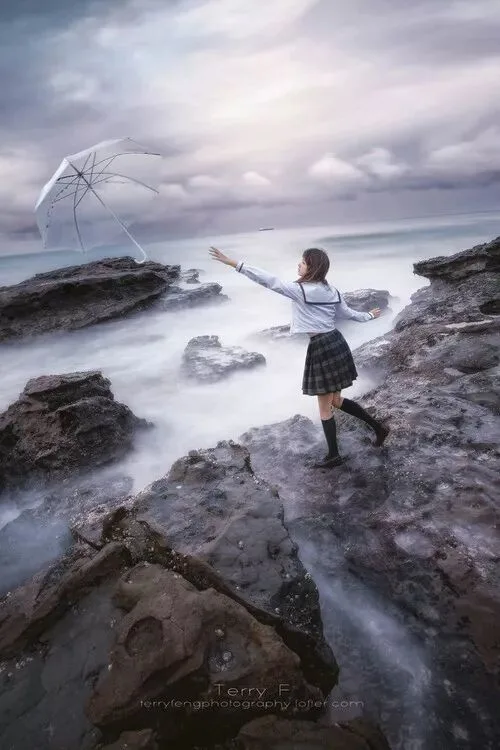
The image above aims to express emotion and story. It mainly employed the following four techniques:
· Action guidance: bringing the model into the theme and emotion, explaining the shoot, and telling her the expected effect of each movement.
· Long exposure: fixing the camera on a tripod, shooting the person and the environment in two passes; the environment shot used a 15-second long exposure to blur the flowing water into mist.
· Environmental HDR: shooting three differently exposed frames of the environment to capture maximum detail.
· Post compositing: merging the person and the environment images into one.
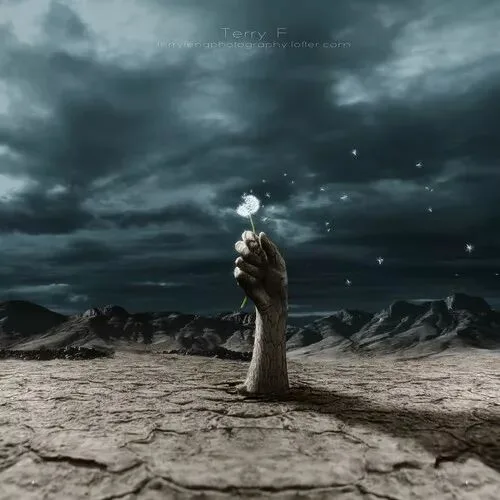
The image above aims to discuss the relationship between humans and nature. It mainly employed the following two techniques:
· Reasonable lighting during the shoot, keeping light and shadow harmonious across the main materials.
· Compositing the materials together in post according to the plan.
Before shooting these photos, I did not yet fully possess the corresponding technical reserve. Only after having the concept and a detailed plan did I begin learning the techniques to realize the idea. Learning technique on the basis of having an idea makes it very clear what you need — so learning is more efficient and targeted, and you can practice directly to consolidate the technique.
It's like renovating a house: most people do the design first and then buy furniture — not buy every piece of furniture available and then design.
3
Weighing Technique Against Ideas
What the vast majority of people lack is not technique; and many people fall into the technique trap, feeling that their photos must be bad because their technique is insufficient.
Once this confusion arises, the following two behaviors easily follow:
· Frantically learning techniques — especially those with simple methods and flashy effects.
· Long-term imitation without seeking progress.
Both problems above are common phenomena in the domestic photography circle — approaches taken to produce "blockbusters" quickly. The result is that everyone's images converge toward sameness, aesthetics converge toward formula, and everyone wants to save effort while still getting shots.
In reality, piling up technique cannot make a photo successful; no matter how much technique there is, it amounts at best to a wallpaper. During my bottleneck period, I shot (produced) quite a few wallpapers.
The image below took about 20 hours from shooting to completion. Yet it is merely a pile-up of technique with no substance. Though this exercise opened the door to post compositing for me, it was never published — because it is just an exercise.
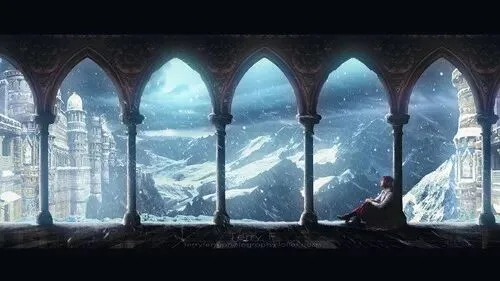
A Brief Process Overview

More importantly, neither technique nor ideas can be acquired overnight. The most eye-catching tutorials — "10 Tricks to Master Composition," "One Little Tip to Teach You Color Grading," "Ten Minutes to a Fresh Pastel Tone" — are also the most harmful for photographers and for enthusiasts with some aspiration.
For photography, whether ideas or technique, the most important way to improve is long-term, steady accumulation. It's like learning English: how many people can go from beginner to an IELTS 8–9 in three months? And IELTS is merely a high-level entry exam anyway.
Under ideal conditions (a photographer without major flaws who studies hard), the development of ideas and technique should both rise continuously, albeit at different rates.
At the entry stage, ideas outpace technique: pick up a camera and you may not find the shutter button, but you cannot have no ideas. As time passes, through learning and practice, a photographer's technique can quickly surpass his ideas — and this is necessary, because some seemingly simple concepts require very high technique to realize.
For a high-level photographer, then, he needs even higher technique to support the realization of his ideas. But technique is relatively finite — the more you learn, the slower the progress; while ideas are endless — the more you think, the more efficient your conception, and the wilder your imagination.
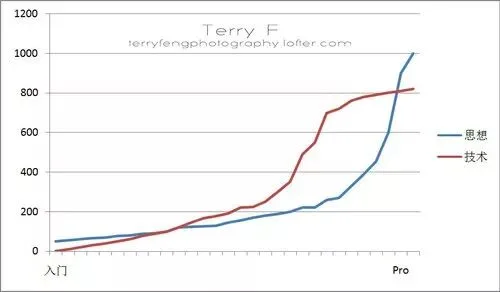
Conclusion
First, pressing the shutter is not a simple matter, nor is it as straightforward as many think — "nothing more than in-camera technique plus post technique" — but a process from obtaining an idea to realizing it.
Second, technique is ultimately only a means of realizing ideas; it determines a work's floor. Ideas are a photo's flash of brilliance; they determine a work's ceiling. You can shoot a meaningful masterpiece with a phone, and you can shoot a mediocre image with medium format.
In the final analysis, what matters most is patience: solve difficulties as they come, and keep an ever-humble heart.
Author of this article:
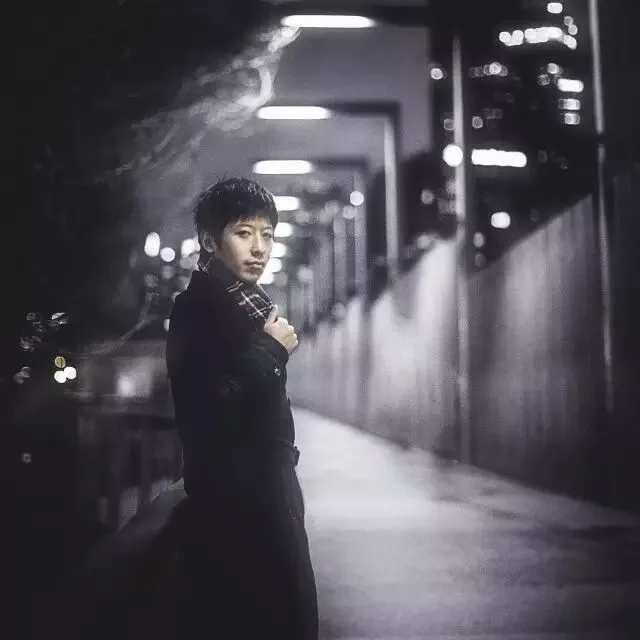
▲ Feng Tao (Terry F) (冯韬)
Getty Images contributing photographer (USA)
Highly popular photographer on Weibo and Lofter
Guest lecturer for Photo Companion (摄影之友), MiPai (米拍), and Nisi