Photography Tutorial · 2019-01-01
Breaking Through: Taking Your Portrait Photography to the Next Level
Thomas Chu Photo
Preface: How do you choose a subject? How do you find models? How do you run the business? How do you stand out? This article tries to solve these problems at their roots.
Contents:
1. The root of confusion?
2. How to find a way out?
3. How to solve the key problems?

The vast majority of people are full of confusion while learning photography. But someone has long since prepared answers to these confusions.
We can easily find massive technical tutorials on major forums, website homepages, and personal blogs, and careful searching — or making good use of Google — turns up quite a bit of photography theory as well.
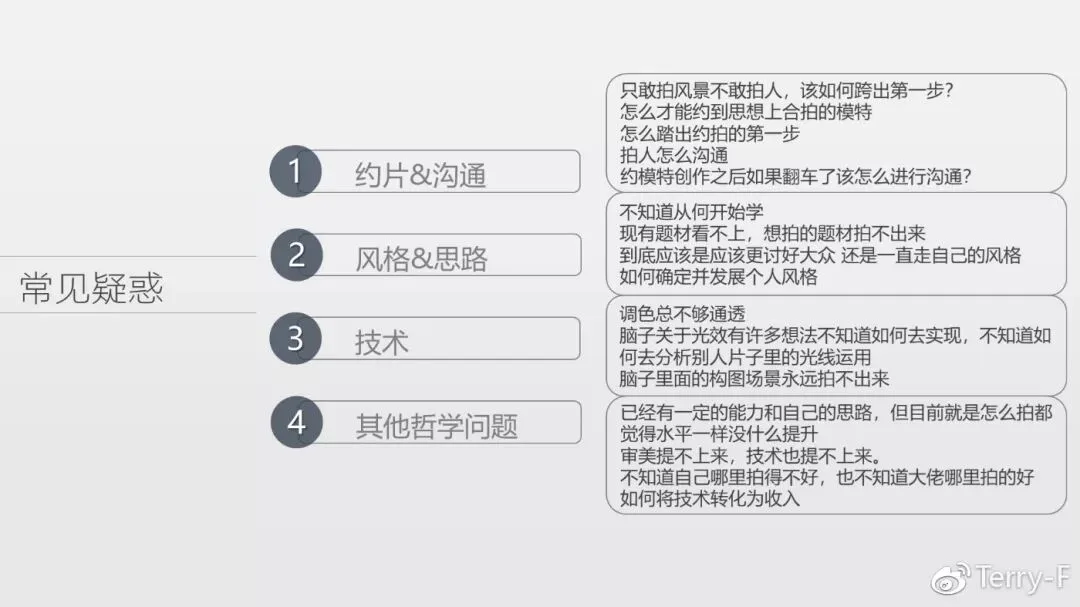
Common confusions from an earlier survey
Yet these don't seem to fully solve the problem. We still don't know how to find inspiration or pick subjects; we can't read great work and can't shoot work we're satisfied with.
Beyond photography itself refusing to improve, we hit walls even in booking shoots, can't turn skill into income, and don't even know how to improve when outsiders criticize us.
At times like this we easily doubt ourselves: have I not studied enough photos? Not practiced enough? Or am I just naturally dull?
Perhaps sometimes the problem isn't a lack of effort or experience, but the wrong way of thinking. Change the way you think, and certain bottlenecks resolve themselves.

(So-called thinking means not only switching your mindset, but also forming the new mindset into a system that rationally replaces long-ossified attitudes.)
1. The Root of Confusion:
If we study photography like a high schooler cramming for exams, failure is guaranteed — becoming a decent craftsman may be the best possible outcome.
For everyone like me who went through a dozen years of test-oriented education, it seems we know nothing besides taking exams.
Photography is a field that requires creativity. We can't find the exam paper, let alone fixed answers — so feeling lost is perfectly natural.
So some people try to write themselves an exam paper: camera parameters, flash power, and lighting angles become the test questions, all of nature becomes the answer sheet, and they turn themselves into a gear instruction manual. The result: you're no longer confused, but you've become the stereotypical gear-head old master. The exam you're best at destroyed your hobby.

2. How to Find a Way Out?
It's not that we can't find what to learn — it's that we don't know how to learn it, let alone how to apply that knowledge to creation. So writing this article is truly difficult: I have to introduce a method you may not believe at all, because this method contains no standard answers.
So I'll use everyone's confusions as cases to draw out the thinking.
2.1 Change the Way You Think
When people can't find a unique subject to shoot, they start from "unique subject" itself and think about solutions there. If you deliberately chase "being different", you'll likely produce photos like this one.

(Author: Guo Yuanliang)
Of course, you might also win an emerging-artist award.
But you can also change the way you approach the problem. Don't drill into the dead end of "uniqueness". No need to find strange models, strike strange poses, use strange grading, or deliberately tell strange stories. Instead, think about how to shoot the "ordinary" with "interest".

(Author: Naufal)
The image above is an ordinary eye — so why did it win an international award? Look closely at the reflection in the eyeball: it carries a little more story than an average eye, and that little bit of added "interest" greatly increases the photo's value.
We can change our thinking not only in creating, but also in running a photography career.

If you're frustrated that you can't find models who click with your ideas, don't rush to find new models who match you. First think about these three questions:
·Are your ideas too outlandish?
·Is your technique not convincing enough?
·Are your expectations of models too high?
Once you feel you've escaped the dead end, you can try planning the next step.
2.2 Set a Long-Term Goal Aimed at Your Confusion
Speaking of long-term goals, the first things that come to mind are probably empty slogans like "I want to become a great artist" — empty words drilled into your head by your mediocre early teachers. So please forget them first.
We can be more pragmatic. Here's a popular example: in the earlier survey, many people asked "how do I find model resources?" We can set ourselves a goal:
"One year from now, I need four high-quality models who can collaborate with me long-term."

Goal: acquire four high-quality models
This is a very feasible and sufficient goal. Next comes thinking about how to achieve it. We may not immediately know how to take the first step, but we can figure out what achieving this goal requires:
· Convincing photography skills
· A first collaboration opportunity with high-quality models
· Just the right way of dealing with people
Now one big goal has become three small goals; achieve them one by one, and the big goal completes on schedule.
2.3 Make Plans for the Short-Term Goals
The first thorny problem: with no models, how do I get practice opportunities and gradually master convincing technique? To get "practice opportunities" you need to lower your standards — start with relatives and friends, start with flowers, grass, pots and pans.

(In my early days, the author also started from flowers and grass.)
Then gradually spread your work through the circles around you, letting classmates and colleagues know you can shoot — and shoot well. After some time, your pool of models expands a bit, and you may even find a few friends who love being shot by you. Then you have two choices:
A: Once you've built a body of work (and gained recognition in your small circles), you can start promoting yourself and doing TFP shoots. This means going through a period of crazy free bookings: shoot anyone, take every job, accept commissions from the second, third, fourth, fifth, and sixth dimensions alike. After a hard stretch, you'll naturally meet a few models you enjoy working with.
B: If you don't want to accumulate slowly, you can sign up for an offline photography class and produce works in batches in a controlled environment. A good mentor can fly you to the top by helicopter — but if you want to find models who truly click with you, you still can't skip the step of mass bookings and accepting everyone.
After the steps above (roughly 6-12 months), your booking career should be on track: a stable client base and a few creative models, plus steady shooting output built on massive practice.
The take-everything booking approach exposes you to all kinds of clients, teaches you to endure and compromise for a goal, and also teaches you to say "no" at the right moment.
In this way, as you gradually achieve the three short-term goals, you also achieve your long-term goal — and you'll find the original long-term goal was actually naive, because the person you are now has higher pursuits.
2.4 Do a Brainstorm
In fact, friends who have confusions do have goals — you just haven't spent time figuring out what your subconscious pursuit really is. People who truly have no goals are mostly complacent, and they don't have confusions either.
The method for dealing with confusion is always the same: find a solution in a suitable way.
That's when doing a brainstorm becomes important.
For example, the most common questions in the last survey were "I don't know what to shoot", "I don't know which subject to start with", "how do I find a personal style" — all of which can be classified as "goal confusion". But as I said, you're not truly goal-less; you just haven't asked yourself clearly.
Questions so tied to your own experience can't be answered by others. Let's try finding solutions from ourselves:
First, unpack the question. "What should I shoot?" has two layers: 1. What should I shoot right now? 2. What should I shoot once my skills are strong?
What you need to shoot now is decided by your future goals, so let's first try to solve the second question.

In this way, one big question becomes two small questions. Find the direction you love (the motivation), and the direction that is meaningful to you (the reward), and you've obtained both the motive and the reward for photography — that's how you keep at it.
Next, seek solutions from the two points above:
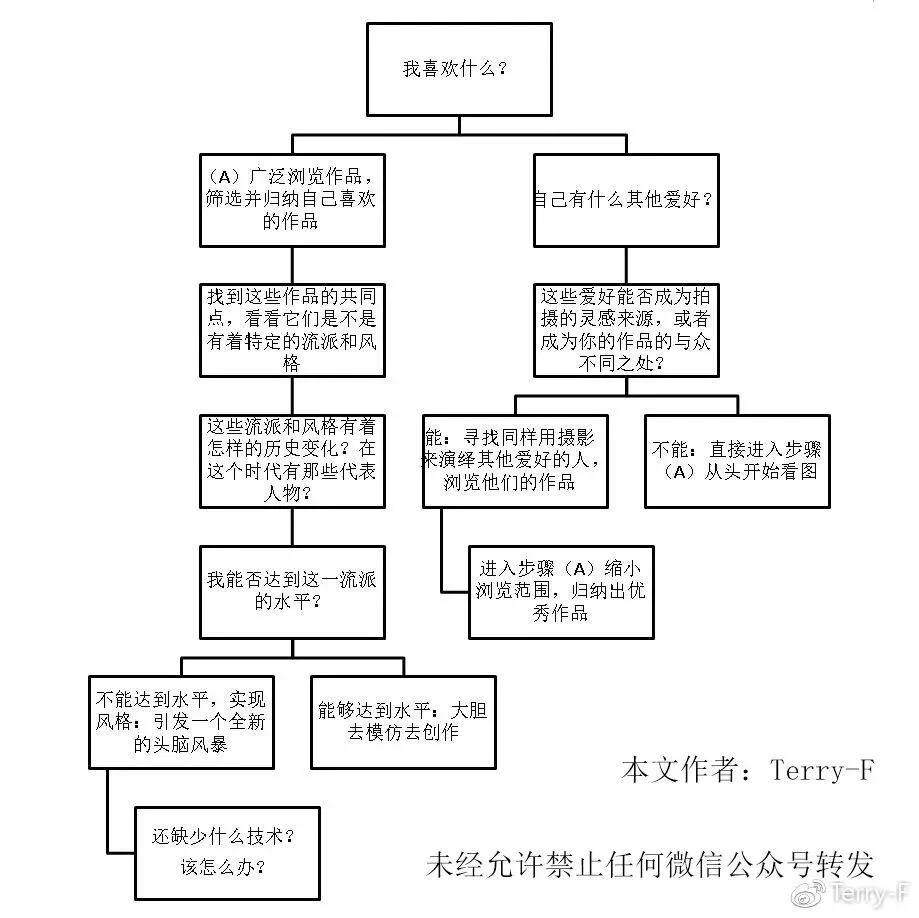
The other question — "what is meaningful for me to shoot" — is this tutorial's homework. Please use the method above to think about how to find the right "reward" (spiritual or material) for yourself in photography.
3. How to Solve the Key Problems?
With the thinking and methods above, we can try to crack the common bottlenecks. Let's analyze the most common technical confusion:
"What do I do when the compositions in my head can never be captured?"
First, break the question down: is your technique insufficient to realize the picture in your head, or are real-world conditions insufficient for the effect?
If technique falls short, you can spend a period deliberately improving it — or moderately lower the standard of the "picture in your head", aiming for part of the effect rather than all of it. If real-world conditions fall short, consider finding a new scene, building one yourself, or moderately lowering the standard. In short, find a balance between effort and compromise — that way, even if you can't capture the exact picture in your mind, you can still produce another kind of high-quality work.

Take this piece: the background in my mind was originally a starry sky, not a forest. But after trying, I found that with my technique at the time, the sky and foreground couldn't blend convincingly. So without changing the theme, I swapped the background for a forest with stronger depth and easier control — and the final result turned out quite well.
Summary
Answering every single question might take a whole book. But after reading everyone's confusions, my bigger takeaway is this: what we lack is not access to technique, but the thinking to understand ourselves and dig out our potential.
Whatever stage you're at — beginner or somewhat famous — when you hit confusion, ask yourself first:
1. What is my ultimate goal regarding this confusion?
2. What short-term goals are needed to pave the way to that ultimate goal?
3. What work does achieving each short-term goal require?
I believe that once you think these questions through with brainstorming, you'll naturally see the solution. Perhaps most solutions point to the same road: "spend more time" and "invest more energy" on effective lines of thought.
If you feel you can't do that, then don't paint your goals too beautifully — and you needn't read this tutorial either.
After all, many people don't truly not know what to do — they just reach for the sky without keeping their feet on the ground.
So what choice will you make next?
I'm looking forward to it.