Photography Tutorial · 2022-11-13
In the Video Era, Does Still Photography Still Have a Future?
In this era of exploding short videos, more and more people have a question: does still photography still have meaning? Does it still have a future? Does it have a unique charm different from video?
In today's video, I'll combine my own experience and creations to share with everyone how much impact video has had on still photography in functions like documentary communication, commercial photography, and artistic expression, based on what I've observed.
And from three levels, I'll give the unique advantages and significance of still photography relative to video, as I've summarized.
Video
▶ Watch the video tutorial on Bilibili
This is the fully illustrated companion to the video above. In this 11-minute talk, Thomas answers a question that keeps coming up in the comments — in the video era, does still photography still matter? Does it have a future? He breaks photography into three tracks — documentary, commercial and art — weighs the impact of video on each, then shares three unique strengths of still photography drawn from his own long practice, paired with keyframe screenshots. Skim the images here for the framework, then dive into the video for the details.
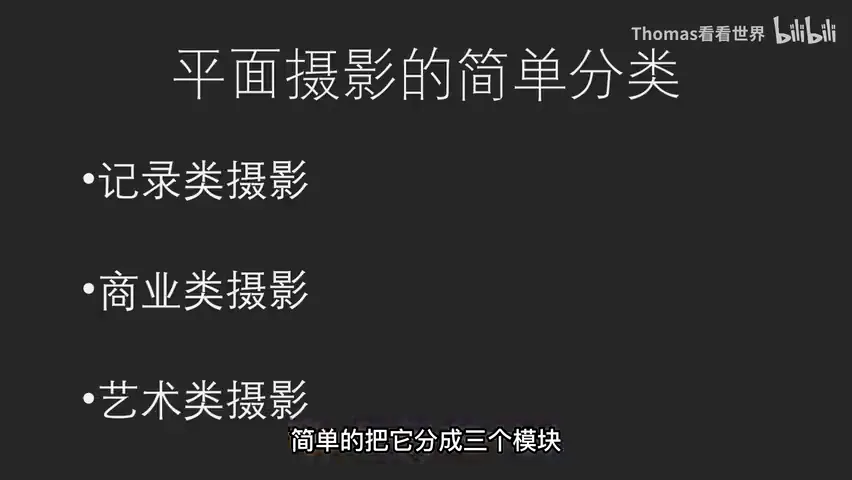
Start with the overview. This classification card, captured at 0:32 in the video, is the skeleton of the whole talk: still photography splits into documentary, commercial and art — three tracks affected by video to very different degrees, each unpacked below.
01 Commercial and Documentary: The Hardest Hit
Commercial first. Traditional advertising, portrait and product stills have been hit hardest — audience attention has migrated to short-video platforms, so advertisers and clients naturally demand more and more video, and commercial still photography has become an ever more crowded, downhill market (at 1:07 in the video).
The new wave of photographer-influencers is another signal. Most of them rose through platforms like TikTok and Bilibili (at 1:50 in the video); their stills are genuinely good, but in Thomas's view their real core product is video — the ability to tell the shooting process in an interesting way. So for anyone aspiring to go professional, his advice is to seize the video opportunity; most of his own commissions these days are not pure samples or product shots either, but bundled creations and releases that pair stills with short- and long-form video (at 2:42 in the video).

Documentary finds itself in a similar position: for news and for understanding how things unfolded, people now instinctively scroll short videos instead of lingering over a captioned photo as they once did (at 3:08 in the video). Photography that serves the media must follow the medium. Of the three tracks, only art — personal expression — is least affected, and that is where the three strengths below take off (at 3:51 in the video).
02 One Image in Place of a Thousand Words
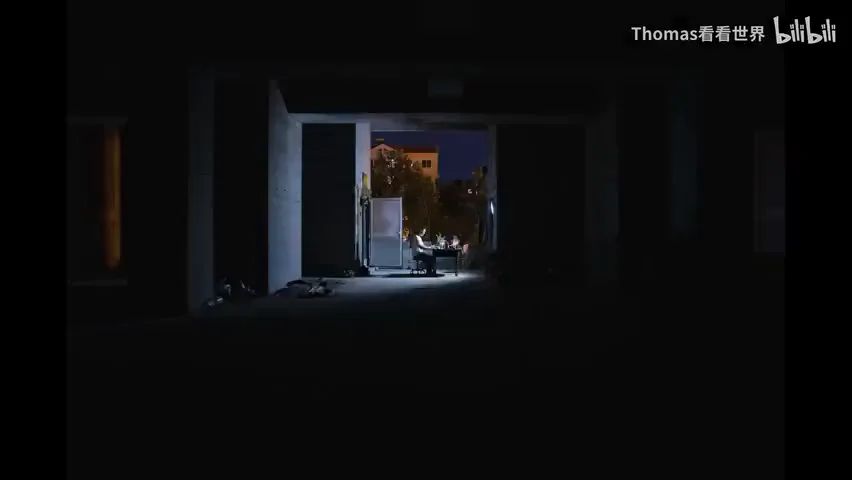
The first strength: one image in place of a thousand words (at 4:10 in the video). To compete with video on a different axis, you have to pour more of your own viewpoint, opinions and emotion into a photograph — let a single image carry what you want to say, exercising the still's power of abstraction and condensation while remaining a depiction of real events (at 5:21 in the video).

The case is Glimmer in the Unfinished Building, which Thomas shot this year (at 4:27 in the video). He first learned of the Xi'an Yihefang project through interview videos from Bilibili creators; for pure storytelling, video is unquestionably the better medium — the owners' hardships, backgrounds and stories, set against their surroundings, travel further than photos with paragraphs of text. But the other way round, by injecting viewpoint and emotion into stills, the series generated remarkable reach — exactly the single photograph's unique power of saying a thousand words with one frame (at 5:13 in the video).

03 A Gaze in Place of a Glance
The second strength: a gaze in place of a glance (at 6:41 in the video). A photograph can hang on a wall and hold someone for a minute or an hour; while scrolling, a video flashes past in an instant, but a still lets the eye stay on the same frame for seconds or tens of seconds (at 6:11 in the video). That demands the photographer bury more detail, more meaning and more of the intended emotion inside the picture (at 6:28 in the video).

The case is the Train China series (at 6:40 in the video): from the start, the shooting asks how to bury the factors of an era, a nation and a society into photographic detail. Take the often-cited frame — luggage stacked inside the carriage, track workers outside, gliding along on self-balancing scooters as they work (at 6:55 in the video): from this you can read that China's infrastructure build-out in the 2020s is a highly mechanized, highly technology-driven operation.
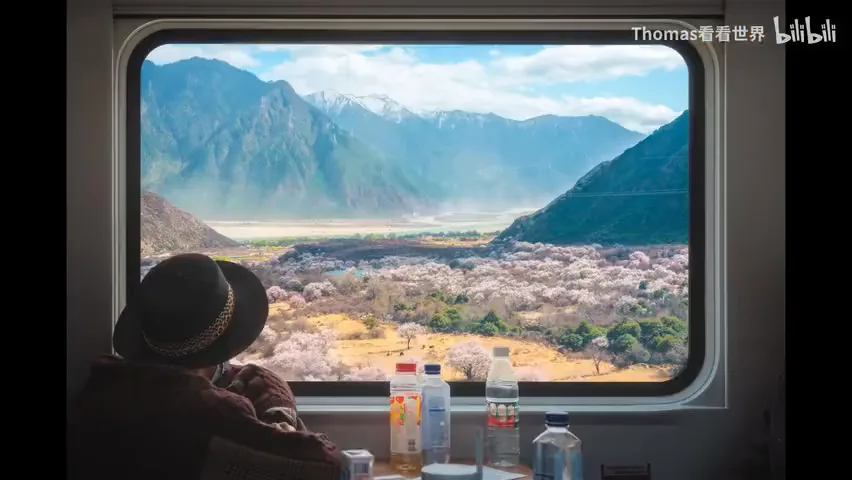
Add the written context: under construction in the frame is the Lhasa–Shigatse section of the Ya'an–Yecheng Expressway — a mega-project running from Ya'an in Sichuan across a thousand kilometres to Yecheng in Xinjiang, planned on a horizon of possibly twenty to thirty years; it was under construction when the photo was made, and has gradually entered trial operation in recent years (at 7:14 in the video). With that background, the photo reveals a nation building grand infrastructure step by step on a long-term plan — an era and a society condensed into a single image, which is exactly still photography's strongest single-frame storytelling (at 8:16 in the video).
04 Expression in Place of Documentation
The third strength: expression in place of documentation (at 8:39 in the video). When photography took over painting's documentary role, it also freed painting from recording into free expression; today video, multimedia and VR are likewise freeing still photography from documentation — in pure recording, stills are simply outclassed by video, so the medium naturally seeks value on the level of expression (at 8:55 in the video): not merely documenting a place, but injecting your own ideas and opinions into it.

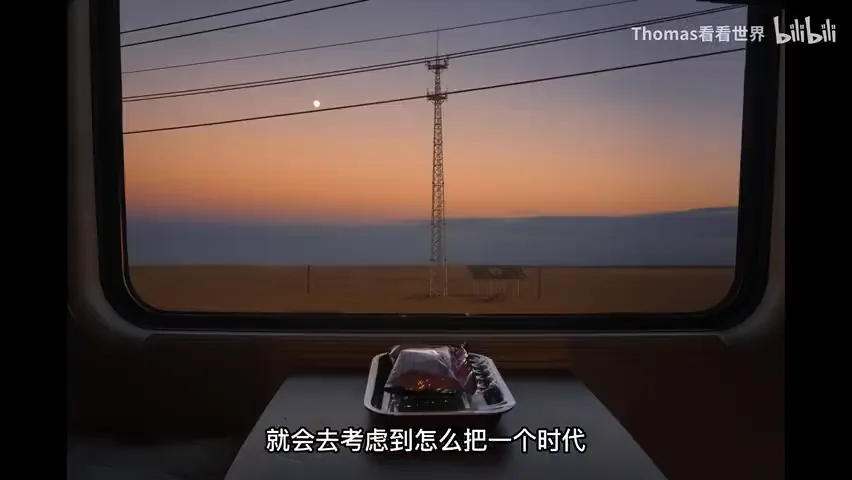
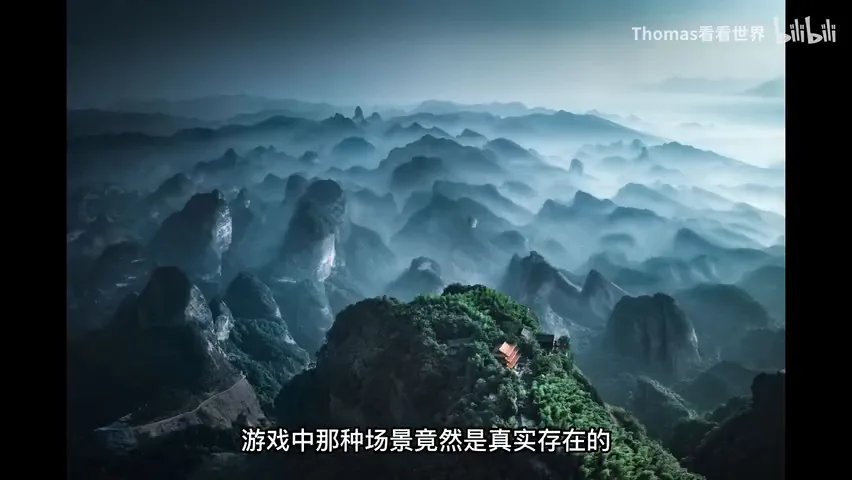
The case is the series Thomas recently shot in Guilin (at 9:22 in the video). It draws not mainly on traditional Chinese painting, but on today's games and on xuanhuan and xiuxian fantasy novels, rendered visually from their world. Many viewers came away saying: so the scenes from those novels and games really do exist — which is exactly the effect he was after (at 9:43 in the video).
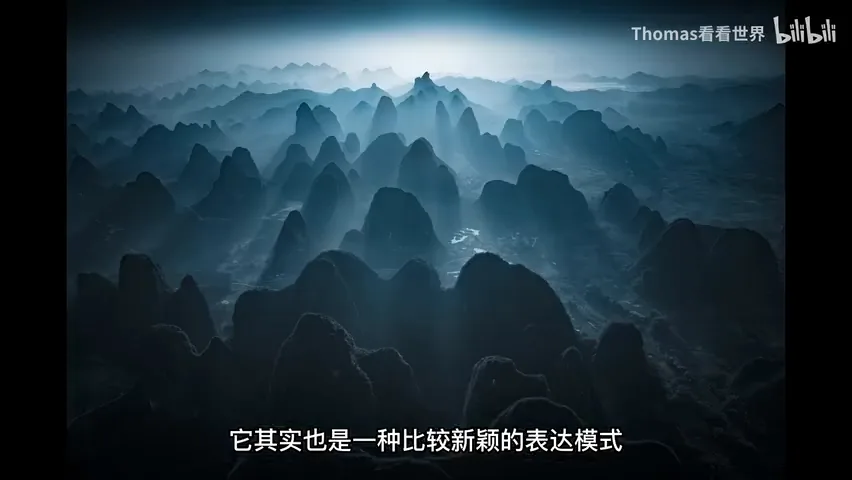
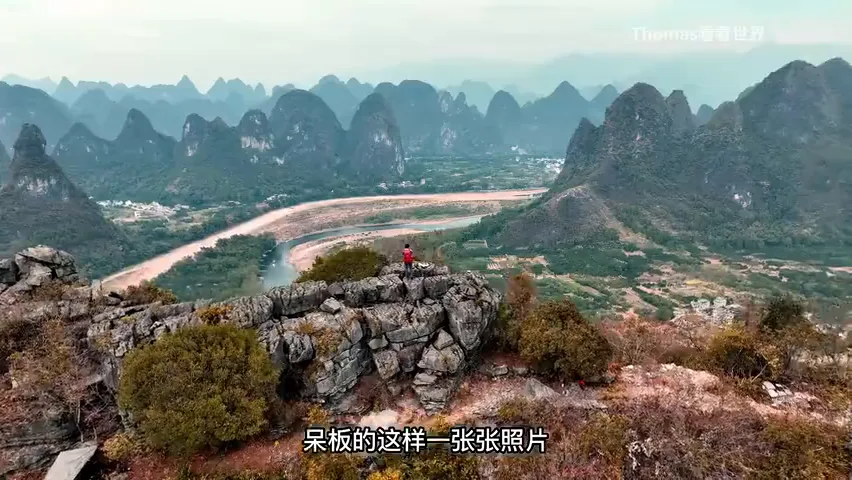
He is candid that if the goal were simply sharing the Guilin that exists, short video plus drone aerials would certainly say more than one stiff photo (at 10:02 in the video); but to express Guilin through a particular palette and exceptionally rich layering, video could do it too — at a vastly heavier workload. Still photography is simply a superb vehicle for expressing the Guilin he wants to show (at 10:25 in the video). This set of mist-wrapped ridgelines, cold and warm interlaced, is the answer itself.
1. Photography splits into documentary, commercial and art: commerce and documentary take video's heaviest hit and must move toward it, while artful expression is least affected; 2. One image in place of a thousand words: infuse photos with viewpoint and emotion, condense intent, and achieve a reach video cannot offer; 3. A gaze in place of a glance: a photo withstands long gazing — bury the information of an era in its details; 4. Expression in place of documentation: cede recording to video, and still photography returns to expression, keeping its own unique territory of advantage.
HD video:
https://www.bilibili.com/video/BV1oP4y127wg/
Related tutorials:
"Landscape Photography Post-Processing Advanced Series Course"
"How to Grade Colors to Look Good? I Summarized 3 Major Rules from Popular Photography Masterpieces!"
"Reject Color Casts! Analysis of Photography Post-Processing Color Management Workflow and Key Points!"
"Five Underlying Photography Post-Processing Concepts More Important Than PS Techniques!"
"Three Major Photography Post-Processing Misconceptions! Have You Fallen for Them?"
"Why Do My Photos Lack Layering? These Three Points Transform Photography Works!"
"How Can Photos Be More Three-Dimensional and Spacious? There's a Trick!"
"These Photography Masterpieces Were Actually All Cropped Out in Post?"
"No Ideas for Photography Post-Processing? Going by Feel? Reconstructing Points of Interest Is Key!"
"Deliberately Overexposing in Post? Photographers Can Operate Like This Too!"
"Pre- and Post-Processing Fully Revealed - Dreamscape Landscape Photography Hands-On Series Course"