Photography Tutorial · 2023-05-07
How to Tell Chinese Stories with Photography? My Attempts and Thoughts~
How to shoot a Chinese perspective with new ideas?
How to reflect China's current sense of the times in photos?
How to use photography to present the achievements, challenges, and future direction of China's development?
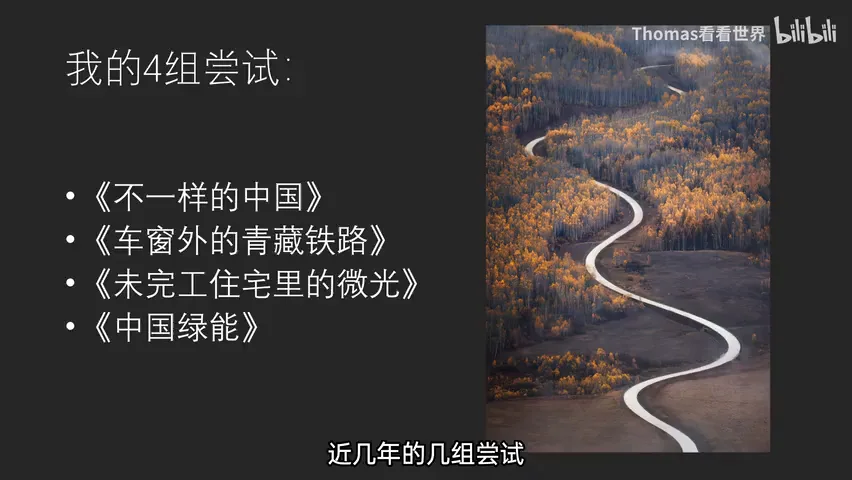
In today's photography tutorial, I'll discuss some of my own attempts and thoughts, drawing on four series I created over the past few years: "A Different China" (《不一样的中国》), "The Qinghai-Tibet Railway Outside the Window" (《车窗外的青藏铁路》), "Glimmers in Unfinished Residences" (《未完工住宅里的微光》), and "China's Green Energy" (《中国绿能》).
Video
▶ Watch the video tutorial on Bilibili
This is the fully illustrated companion to the video above. How do you tell China's stories through landscape photography? Drawing on four series created in recent years — A Different China, The Qinghai-Tibet Railway from the Train Window, Glimmers in Unfinished Homes, and China's Green Energy — Thomas shares his attempts and reflections in one pass. Keyframe screenshots are paired below, including the introduction card for each series; skim them for the framework, then hear the full telling in the video.
Start with the overview: this contents card, captured at the opening of the video, lays out four series that trace an evolution from landscape toward documentary. Each is unpacked below.
01 Why Tell China's Stories
The first reason is a reflection following his 2019 National Geographic award. Across four trips to Greenland totaling half a year, Thomas realized his perspective was still largely that of a tourist, a traveler — the Greenland such photos show may not be what local people care about most, nor their deepest experience of the place (at 0:30 in the video).
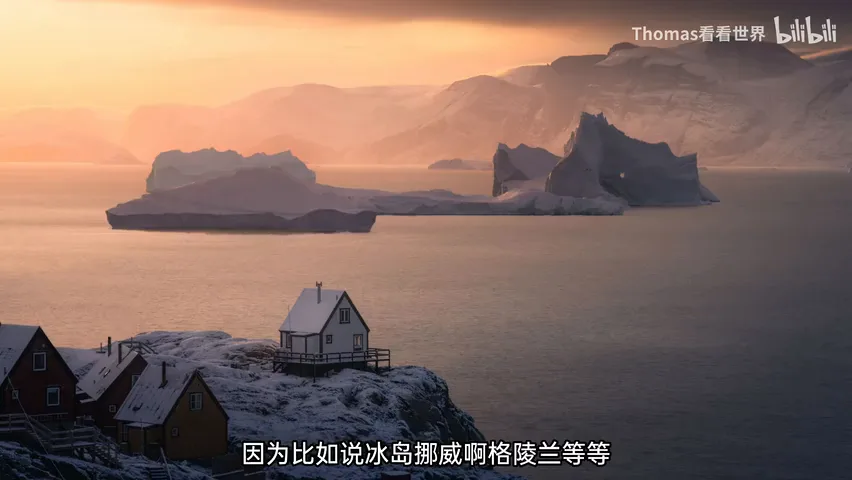
The second reason is more practical: shooting China's landscapes well is actually harder than shooting foreign ones. Few people have been to Iceland, Norway or Greenland, so any image feels fresh; but Huangshan, Guilin, Beijing and Shanghai are sights we all know — making them look distinctive is a question that demands an answer (at 0:57 in the video).
02 Attempt 1: A Different China
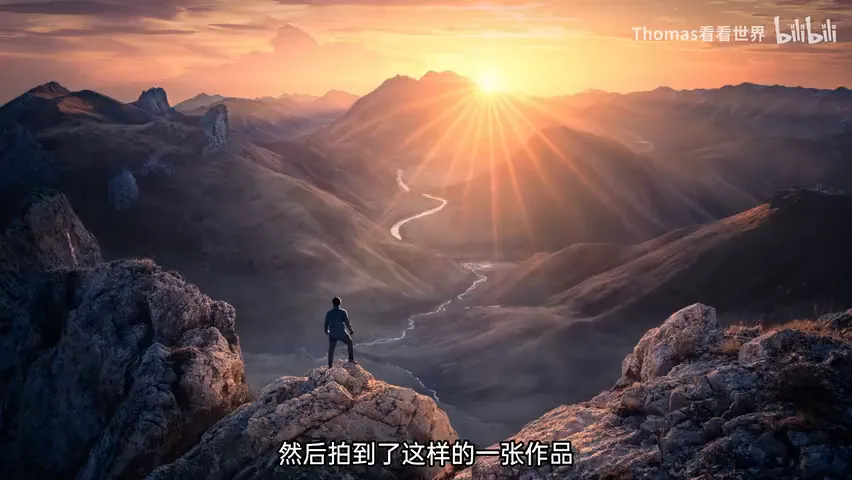
The first series applies "the color styles popular in the West" — the landscape techniques Thomas honed abroad — together with modern tools like drones and satellite maps, to show a different side of China's nature and cities. The photo below, taken in 2020, was widely assumed to be Iceland or Norway; it is actually in Nagqu, Tibet. He first located the spot via satellite maps, scouted the stepping stones and the river's course with a drone the day before, judged that the next morning's sunrise would look stunning, then started climbing after four a.m. to capture it (at 1:44 in the video).
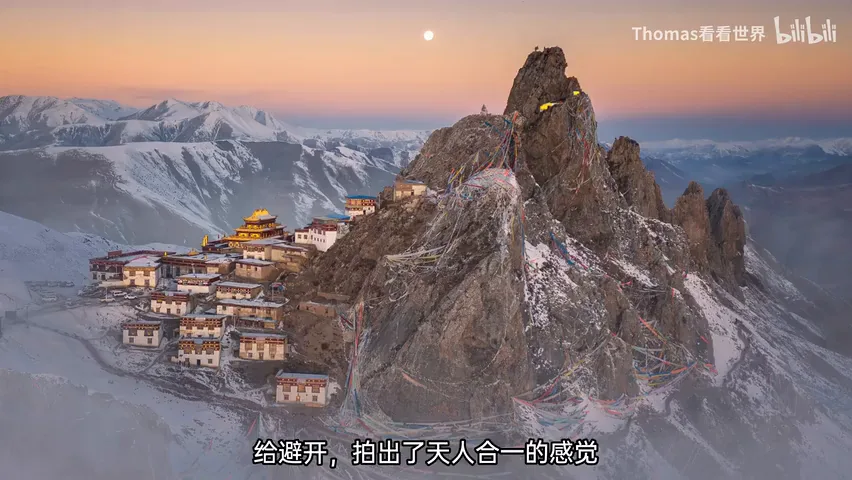
A drone can also find remarkably clever angles. In this frame of Zizhu Monastery in Dengqen, Tibet, the drone sidesteps the monastery's more cluttered parts and distills a sense of unity between architecture and landscape (at 2:20 in the video).
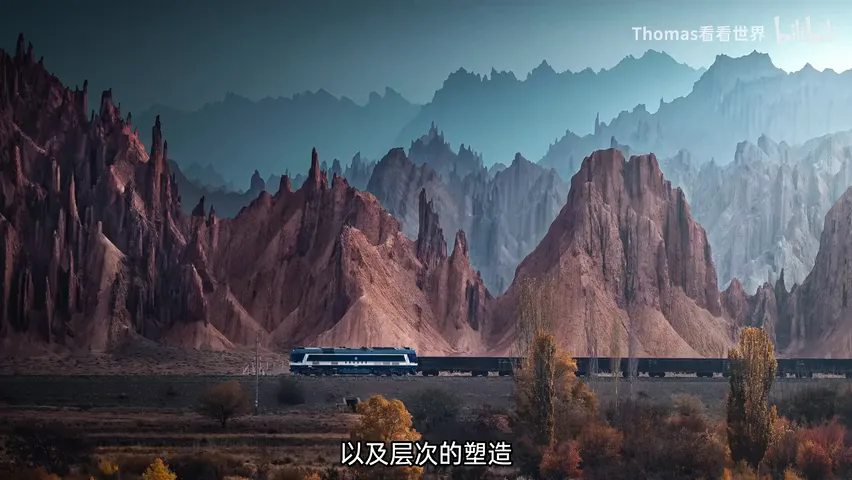
Some scenes come down to awareness. The frame below lies along Xinjiang's wildly popular Duku Highway, where earlier photographers rarely saw the potential; passing by, Thomas realized that shaping depth and layers — and waiting for a train to pass at exactly the right moment — would produce a strikingly different image. The series also borrows color inspiration and style from Chinese painting, and weaves in more narrative viewpoints: his Bund photo, for instance, captures Shanghai's surreal glamour while also showing young people walking with eyes glued to their phones (at 2:33 in the video).
03 Attempt 2: The Qinghai-Tibet Railway from the Train Window
The first series' biggest shortcoming, by Thomas's own account, is that shooting the mountains of Huangshan, Guilin or Tibet looks little different in 100 years ago's China or 100 years hence — it lacks a sense of the era. The remedies: find landscapes that carry the marks of the times, and borrow from documentary photography, using personal, micro-level perspectives to speak to grand themes (at 3:43 in the video).
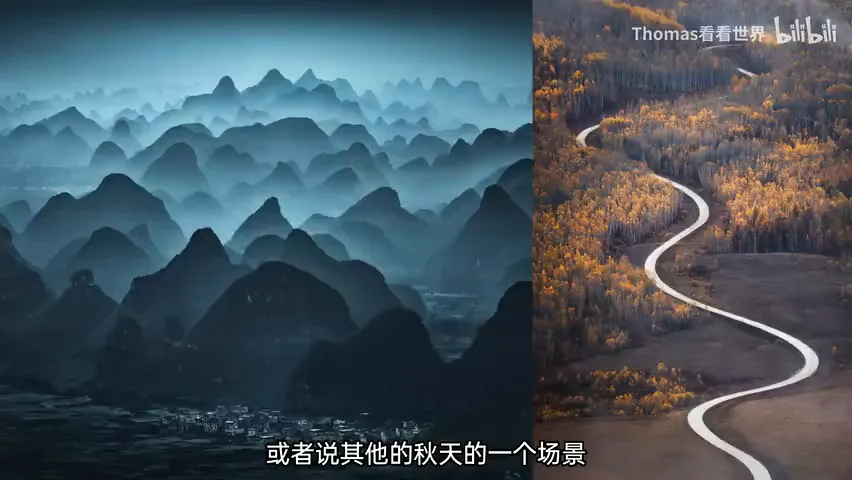
In mid-2020, on a train, he noticed how beautiful the view outside the window was: beyond the endless Gobi, wind turbines, solar plants, cities, factories and villages kept rolling by. China now has the world's longest passenger rail network — the only country where a train, that thoroughly modern conveyance, can carry you past plateaus, lakes, snow mountains, forests, metropolises and hamlets alike. Modern riders no longer treat the train as living space; most stare at their phones. So Thomas focused his lens outside the window — era-defining buildings outside, and inside, passengers' clothing, expressions and luggage recording a changing China (at 4:26 in the video).
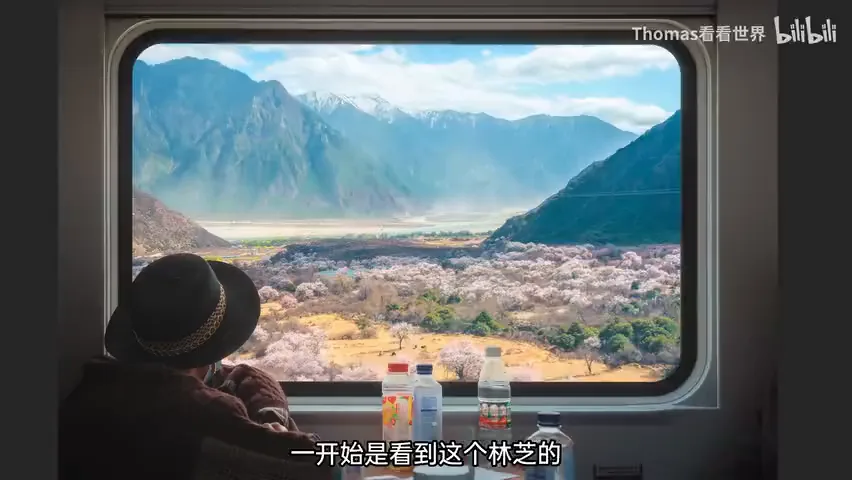
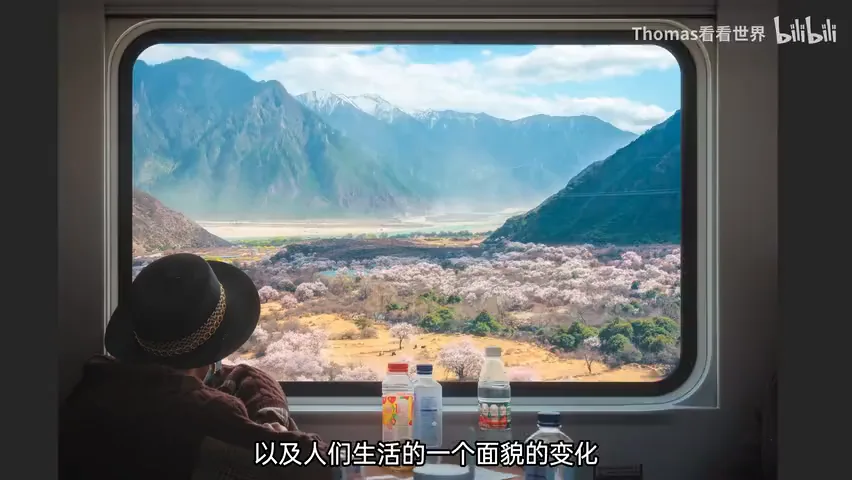
Where photography differs from video is that a still image can be gazed at — viewers can spend thirty seconds or a minute quietly savoring an instant that flashed by in a thousandth of a second. So he buries abundant details in every frame: in the photo below, you first see the beauty of Nyingchi's peach blossoms, then the "eyesore" row of plastic bottles in the foreground — water bottles, soft-drink bottles, cups — a deliberate setup, for that little table perfectly captures the abundant choices of a consumer society; and the tall transmission towers on the distant snow mountains belong to eastern Tibet's power grid, recording the change in Tibetan society and daily life (at 5:52 in the video).
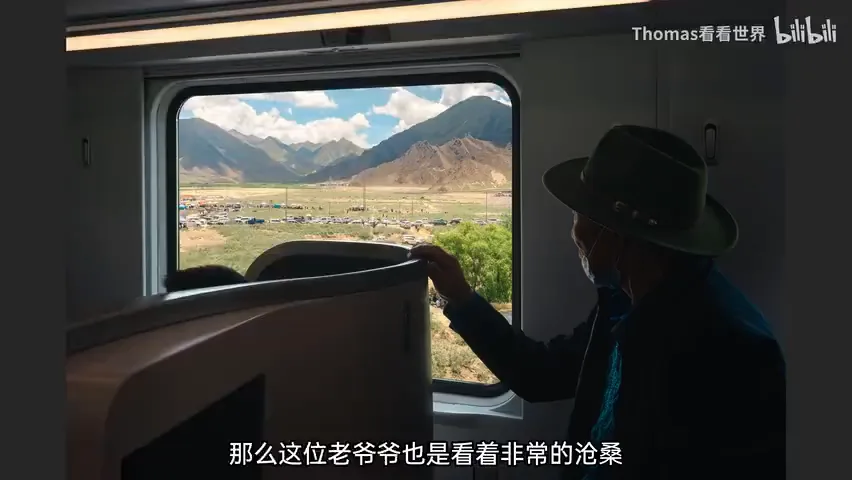
Another frame, "Roads to the Sky": what bind inland China and Tibet together are not only the train he rides, but the Qinghai-Tibet highway outside the window, plus oil pipelines, fiber-optic cables, power lines — countless threads pulled tight. On the second day of the Lhasa-Nyingchi railway's opening he flew straight there and booked a business seat, recording a Tibetan family — the grandfather, face full of hard-won years, a witness to Tibet's modern history; outside, a traditional highland market, inside, a brand-new Fuxing EMU. He also photographed many people, among them a university teacher in Lhasa framed against a traditional herder's house — as technology and the economy develop, life offers more choices (at 6:45 in the video).
04 Attempt 3: Glimmers in Unfinished Homes
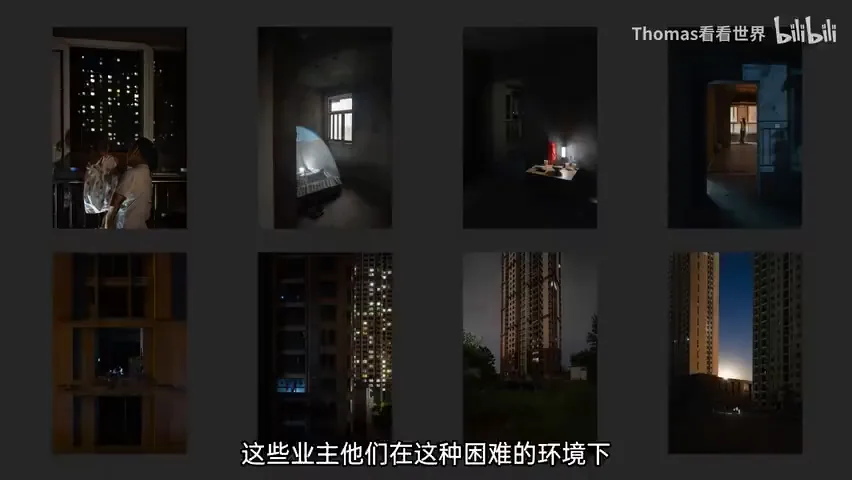
A changing China has known achievements but also problems — and could those problems offer lessons for the future, and for other developing countries? That question spawned last year's series. Drawing on art photography, Thomas shot the entire series at night, using faint glimmers in the darkness to show homeowners still living with determination and working toward resolution in difficult circumstances — an approach that readily evokes empathy (at 8:23 in the video).

The series spread widely at home. Amid extensive media coverage, Yihefang — the Xi'an project he photographed — was officially handed over to buyers at the end of last year; disputes over completion fees remain, but a solution now exists, which is already a good outcome. The series also won a 2023 World Press Photo award (at 9:22 in the video).
Many wonder: should such stories be told and debated in an international context? Thomas believes yes. For real events that are not highly sensitive, if our own objective, neutral reporting stays silent, the discourse risks being captured by conspiracy theories or bad-faith actors stirring the pot. When we tell it ourselves, we hold first-hand material and the power to define and interpret the narrative — in interviews with foreign media and in captions, he can lay out the full story and forestall misunderstanding. The precondition, of course, is a truthful and objective standpoint (at 9:52 in the video).
05 Attempt 4: China's Green Energy and the Road Ahead
Talking with the West reveals disagreements — but can we seek common ground while reserving differences? Global warming and the environmental crisis have made sustainability a universal concern, and under that topic China, Europe and the United States can find shared positions. Building communication on those commonalities and gradually dissolving misunderstanding helps, ultimately, toward a shared future for mankind. And China is genuinely ahead in this field: solar power, ultra-high-voltage transmission, electric vehicles — from generation to transmission to consumption, a complete solution has taken shape, with leading technologies and companies across these industries (at 11:31 in the video).

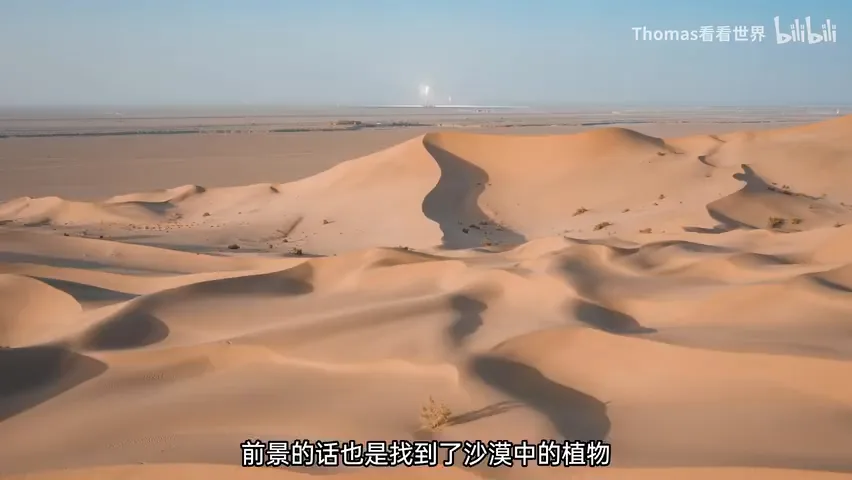
So this year's China's Green Energy series aims, through photos and short videos together, to investigate and present the "China solution" in sustainability in depth, exploring how these projects affect industry, residents' lives, the environment and local communities. In the frame below of the Dunhuang concentrated solar power station, desert plants were deliberately chosen for the foreground: they show the local environment, and they echo a lineage — photosynthesis in desert flora and humanity's harnessing of light are, in essence, the same story. The series, still being shot piece by piece, will combine in-depth reporting with visualized imagery (at 12:59 in the video).

1. Shooting your own country is the harder task: a tourist's eye is not enough — seek out landscapes that carry the marks of the era, and address grand themes through personal, micro-level perspectives; 2. Technology is the key to a new kind of landscape photography — satellite maps for scouting, drones for access and angles, telephoto compression — all can make familiar scenery fresh again; 3. A photograph can be gazed upon: bury details in the frame so viewers find a minute's worth of reading in a thousandth of a second; 4. Tell China's stories with achievements, problems and the future in equal measure, grounded in truth and objectivity, holding the power to define the narrative with first-hand material.
HD video:
https://www.bilibili.com/video/BV1oV4y1k79m/