Photography Tutorial · 2025-04-20
The Iconic Trump Assassination Photo Lost? Reviewing the World Press Photo 2024 Winners!
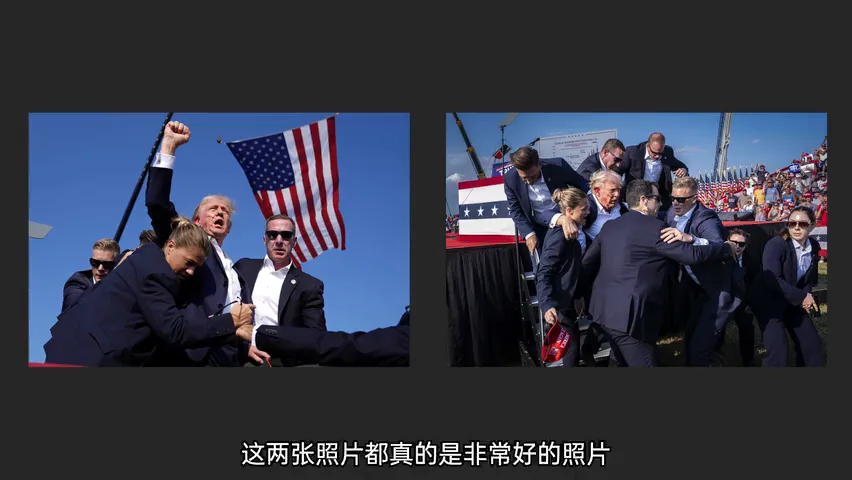
Last year, Evan Vucci's photo of the Trump assassination attempt, with its decisive-moment capture and clean yet powerful composition, was hailed by netizens as a masterpiece of photojournalism.
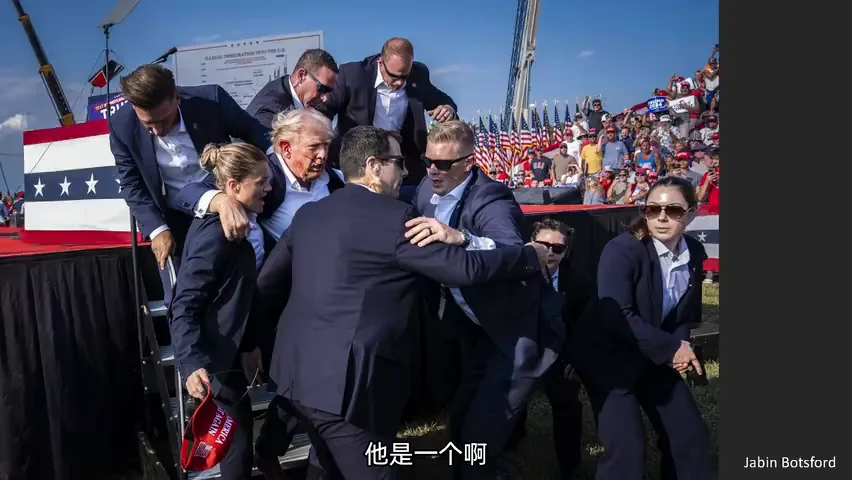
Unexpectedly, in the just-announced 2024 World Press Photo Contest, this masterpiece did not win. The award went to a photo taken at the same scene by another photographer.
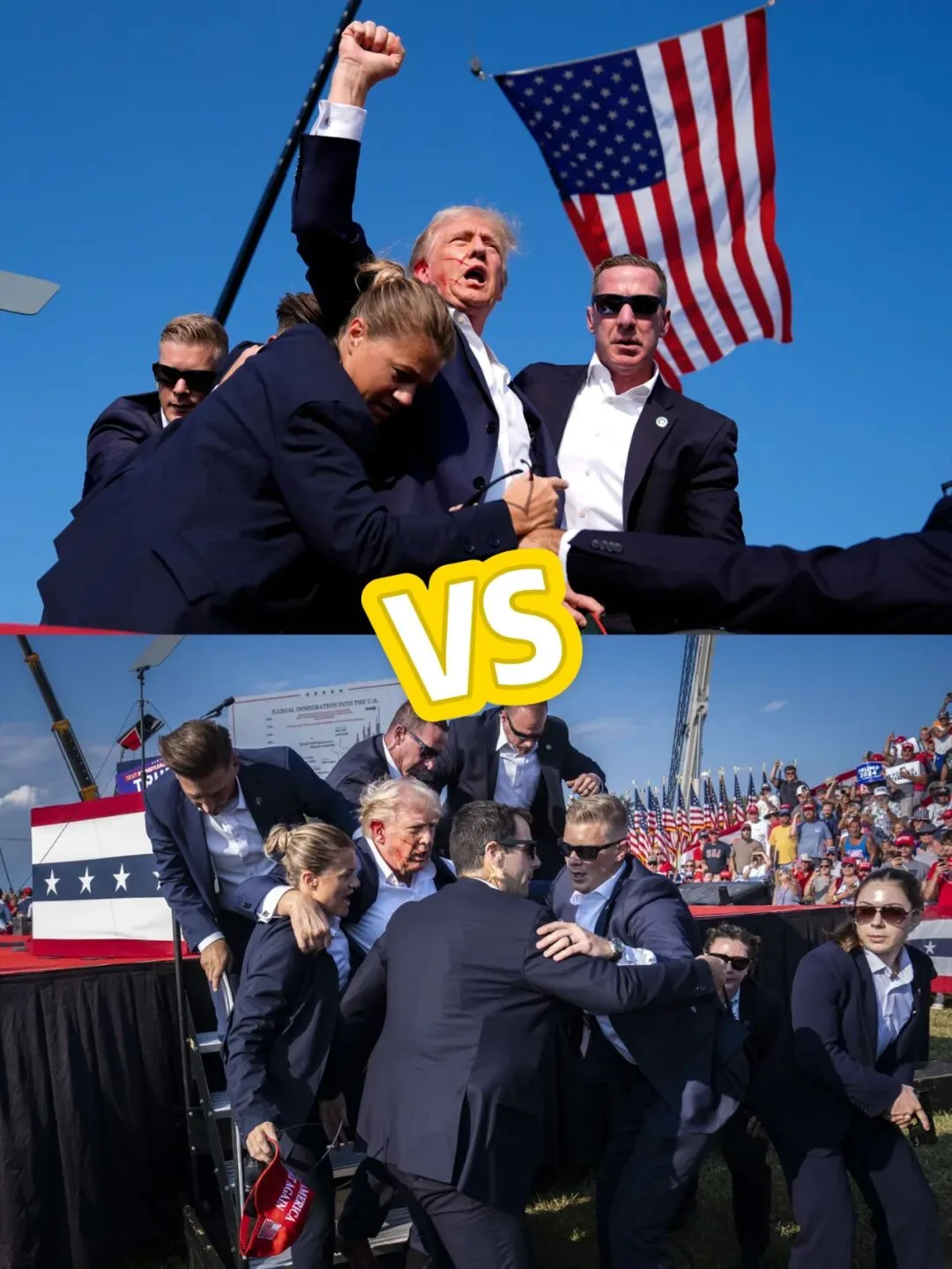
Today Thomas will explain this and compare the respective strengths of the two photos.
Video
▶ Watch the video tutorial on Bilibili
This article is the illustrated companion to the video above: after the 2025 World Press Photo results were announced, the biggest talking point was not who won, but that Evan Vucci's viral Trump assassination photo lost — and the winning frame came from another photographer on the scene, Jabin Botsford of The Washington Post. This is Thomas's full comparison of the two images.
The conclusion first (at 0:38): both are good photos. Evan Vucci's frame is unquestionably the more viral one, while the winning photo has more documentary value; the left is better looking, the right more rewarding to look at — the left hits hard and clean, the right runs deeper, more layered, with a fuller, richer and slightly more objective view of the event.
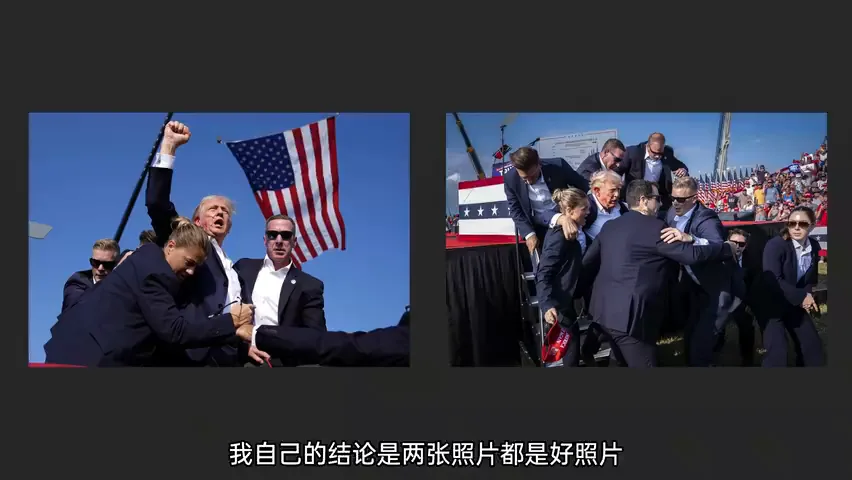
01 The Decisive Moment and the Hero Narrative
Start with Evan Vucci's photo (at 1:38): Trump's clenched fists and hard gaze form a textbook decisive moment; the photographer shot from a low angle — looking up makes the subject tower, looking down shrinks him, and only the level view is objective; paired with the raised fist, the American flag behind and a comparatively clean background, the whole frame feels like a hero's return. Its visual impact is enormous.
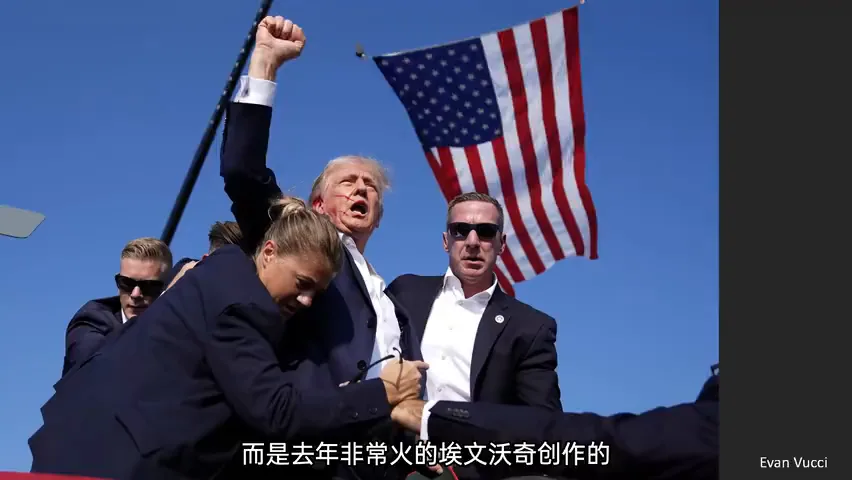
Yet if one photo is to reflect the whole event, this one is remarkably one-sided (at 2:25). Watch the full footage and you see: Trump first touches his ear not knowing what happened, then panics and is pinned down by agents, suddenly senses the moment and springs up, fist raised, working the crowd — only to be dragged down again, his expressions and inner shifts shifting constantly along the way. Politicians perform by nature, and this photo captures precisely the performed hero moment.
02 Where the Winning Photo Wins
Now the winning photo (at 3:14): Trump's expression carries resolve and fear and bewilderment all at once — hemmed in by bodyguards, wobbling as he is hustled down the steps. It is a richer, truer state of the man. The information is fuller too: Trump, his agents, and behind them the supporters with raised fists are all in the frame.
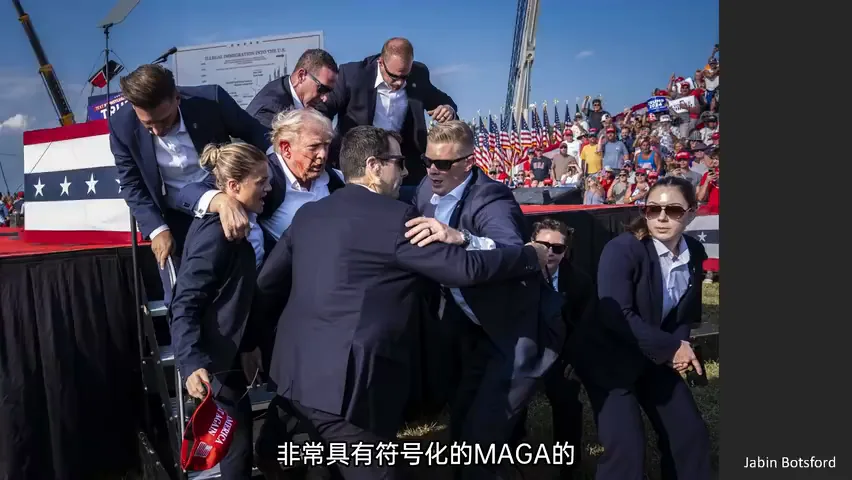
The details reward study (at 3:51): the agents, though all bodyguards, move and look completely differently; the iconic red MAGA cap is in an agent's hand, not on Trump's head; the foreground is a wall of suits — the ruling class — while behind them stand voters in T-shirts and jeans, a totally different visual register, opening the photo to endless reading. With a level viewpoint and an unperformed, truthful moment, it simply offers more to unpack.
03 There Is More Than One Standard for a Good Photo
Journalism prizes relative objectivity and completeness (at 4:54). From a photojournalism and World Press Photo standpoint, the winning frame is clearly the better one; but on pure virality, nothing from that scene touches Evan Vucci's classic. Comparisons need a coordinate system: on spread, Vucci wins; on complexity, depth, objectivity and completeness, the winning photo — or other angles — do. There is no single standard for a good photo; it depends on what you are chasing.
04 Your Purpose Sets Your Standard
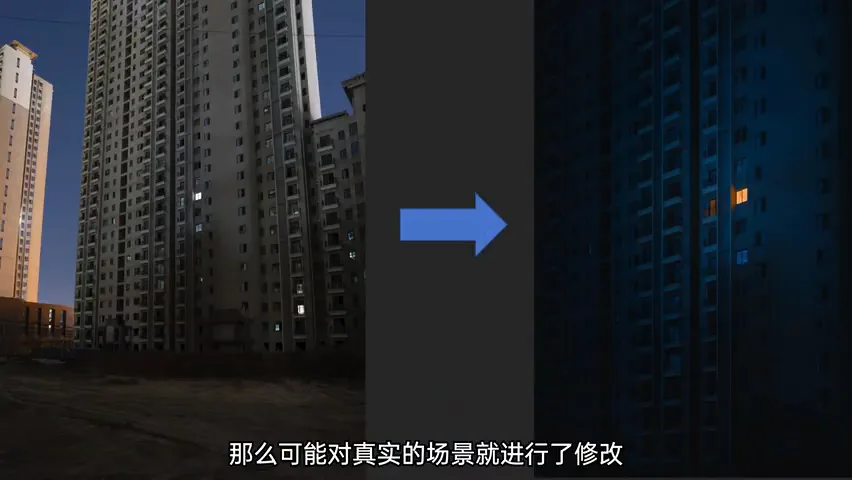
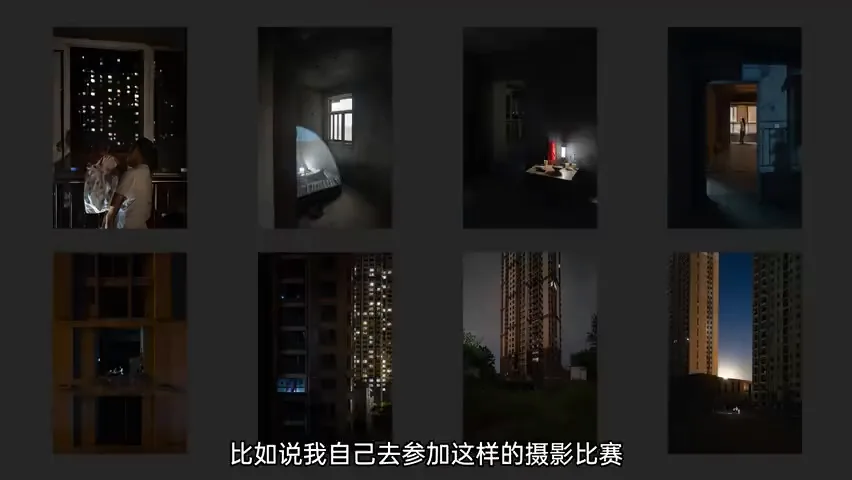
Thomas shares his own experience (at 5:44): for one project he edited two sets of photos. The set for the internet altered the real scene, layering in subjective color and mood — more striking, more shareable, more artistic; the set for competitions, meant to show the event truthfully and completely, was edited differently. When creating, a photographer must ask: is this set meant to record a real moment, to express myself, to go viral, or to earn commercial return — the purpose defines the judging criteria.
So back to the two photos (at 6:43): one is a superb image for spreading, the other — for World Press Photo and journalism of this kind — is more rewarding, more complete and richer. Both are truly good photographs.
1. There is no single standard for a good photo: virality, documentary value and artistry each have their own coordinate system — know what you are chasing first; 2. Low angles, flags and clean backgrounds can build a hero narrative, but may also push the frame toward one-sided propaganda; 3. Photojournalism prizes relative objectivity and completeness — the density of detail and room for interpretation is what makes an image rewarding; 4. Define your purpose before creating — record, express, spread or sell — for it decides how you shoot and edit.